Tinnitus: A Widespread Condition—approximately three million people in Germany now suffer from an unpleasant ringing in the ears. That amounts to 15 percent of the total population. The sounds usually occur in only one ear, though sometimes in both. Why people suddenly develop tinnitus has not yet been definitively determined. Causes can include both organic factors, such as inflammation or sudden hearing loss, as well as emotional and physical strain or stress. In a stressful situation, for example, the hormone cortisol is released, which can lead to poor blood flow to the inner ear. And it is precisely this blood flow that plays a crucial role in maintaining healthy hearing. However, the most common cause of tinnitus is hearing loss. In fact, about 80 to 90 percent of all tinnitus patients typically have an undiagnosed hearing loss at the same time.
How are tinnitus and hearing loss related?
The bothersome ringing in the ears is often caused by a decline in the ear’s filtering function. When this happens, these auditory filters are no longer able to filter out the ringing or perceive it as background noise. As a result, those affected primarily hear the bothersome ringing; they are unable to block it out. Tinnitus can be treated by improving hearing. Both hearing aids and a modern inner-ear implant—a cochlear implant—can help with this.
How the Inner Ear Implant Works for Tinnitus
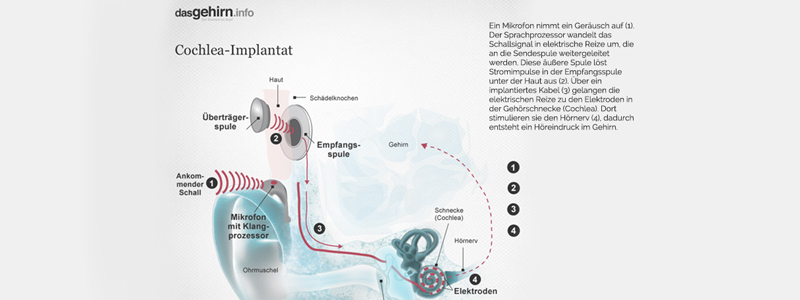
A cochlear implant is a hearing aid for people who suffer from severe hearing loss, inner-ear hearing loss, or even complete deafness. Often, the hearing loss is caused by damage to the hair cells in the inner ear (cochlea). Since tinnitus is caused by changes in the activity of the auditory nerve, which is associated with hearing loss, a cochlear implant can help in this case. It consists of a speech processor, which records sounds outside the body and converts them into digital impulses. And the impulse converter, which is implanted under the skin behind the outer ear and detects external signals. These signals are received by the transmission coil through the skin, converted, and transmitted via fine wires to the electrodes located in the inner ear. In this way, the implant takes over the functions of the part of the inner ear that is no longer working and transmits the audio signals to the auditory nerves and on to the brain. Those affected hear better again, and the tinnitus becomes quieter or disappears.
You can find out more about cochlear implants as an alternative to hearing aids in our article “When Hearing a Whisper Becomes a Magical Moment.”