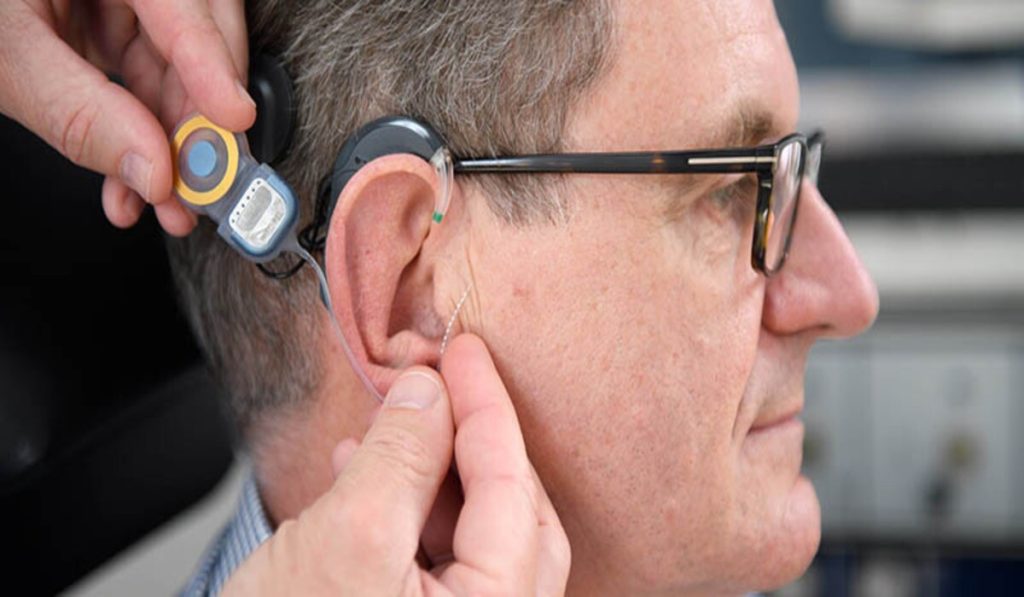
“It’s a miracle that I can hear again,” says Hartmut Blum, a 61-year-old COVID-19 patient. He became seriously ill with COVID-19 and had to be placed on a ventilator for two weeks in the hospital. Afterward, he woke up exhausted, with severe tinnitus in both ears—and no hearing.
The engineer has no memory of his time in the intensive care unit. When he wakes up, he doesn’t know where he is or who the people around him are. He slowly fights his way out of what is known as delirium—a temporary clouding of consciousness that many patients experience after mechanical ventilation.
Hearing Problems Caused by a COVID-19 Infection
But Hartmut Blum’s decline wasn’t just physical. His hearing has also been affected. “When I came to, it was incredibly loud. The noise prevented me from understanding the doctors. I told the doctors about the noises and that I could no longer hear anything in my right ear. A test revealed that I was suffering from bilateral tinnitus,” he says, recounting that shocking realization.
Tinnitus, hearing loss, and hearing problems caused by COVID-19 are possible. This is because the virus affects more than just the sense of smell and taste.
Two researchers at the University of Manchester have studied hearing problems caused by COVID-19. Their findings showed that in approximately 14.8 percent of the cases described in the studies, tinnitus occurred after a COVID-19 infection; 7.6 percent experienced hearing loss; and 7.2 percent experienced balance problems and dizziness. Those affected included infected individuals from all age groups, and the severity of their COVID-19 illness varied. Further systematic studies on hearing problems caused by COVID-19 are still pending. Hearing impairments and problems can also be caused by other viral illnesses such as measles, mumps, and meningitis.
If hearing problems or tinnitus occur after an infection, those affected must undergo a thorough examination and receive treatment from an ENT specialist immediately.
Hearing Again with a Cochlear Implant
Hartmut Blum was transferred to the Ear, Nose, and Throat Clinic at Hannover Medical School for further treatment of his hearing problems caused by COVID-19. Prof. Prof. h. c. Dr. med. Thomas Lenarz, a specialist in cochlear implants, works there.
His further examinations confirmed that Hartmut Blum’s hearing had been severely impaired by the COVID-19 infection. But there was reason for hope: even though the hair cells had been destroyed, his auditory nerve was functioning perfectly. Therefore, a cochlear implant (CI) was a suitable solution. “The cochlear implant bypasses the hair cells and sends the sound information directly as an electrical signal to the auditory nerve. From there, the impulses travel on to the brain, where they are then perceived,” explains Lenarz.

What is a cochlear implant, and how does it work?
A cochlear implant(CI) is a hearing system for people with moderate to severe hearing loss whose auditory nerve is still functional. It converts sound into electrical signals and transmits them directly to the auditory nerve. This allows the damaged areas in the ear to be easily bypassed.
Hearing implants essentially consist of two parts: an external part, the audio processor with a transmission coil, and an internal part, the actual implant with its electrode array, which is surgically implanted under the skin.
Physically, Hartmut Blum has gradually fought his way back into his daily routine—and has grown accustomed to his new hearing with the cochlear implant. A few weeks after the surgery, the extensive initial fitting of his hearing system took place. Adjusting to his new hearing is exhausting for many CI users at first: “During the day, I was still very tired and had trouble concentrating,” says the engineer. “Just two months after the CI surgery, I decided to return to work anyway.” Hartmut Blum now also has a cochlear implant in his left ear and is very satisfied with the sound quality: “It brings another improvement in terms of sound localization, sense of balance, and speech intelligibility. The tinnitus is also better suppressed.” In his job, he’s responsible for the South American markets, and with his two cochlear implants, he’s now able to handle conference calls again. He says he’s actually experienced three miracles: “That I survived COVID-19, that I can hear again, and that I have a wife who truly stands by me.” He strongly warns others against contracting COVID-19 and hopes that people will take the virus very seriously so that others are spared what he has gone through.
Here you can learn more about the miracle of hearing with cochlear implants and proper follow-up care.