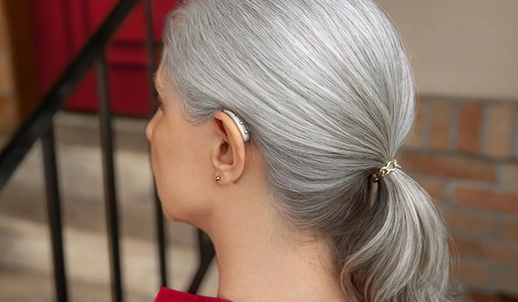

How are tinnitus and hearing loss related?
Tinnitus and hearing loss often occur together. The German S3 guideline on chronic tinnitus even cites a rate of over 90 percent. Many people with tinnitus are initially unaware of their hearing loss, as it develops gradually and can go unnoticed for a long time.
Hearing loss most often begins in the high-frequency range. You may still hear sounds loud enough in everyday life, but you’ll find it increasingly difficult to understand speech. This becomes noticeable, for example, in restaurants or other noisy situations. Often, the environment initially seems to be the cause, even though your hearing is already processing certain frequencies less effectively.
The onset of tinnitus may also be related to this lack of acoustic input. Put simply, when fewer signals from the inner ear reach the brain, the central auditory system increases its sensitivity. This mechanism, known as central amplification, is one of the most important explanations for tinnitus associated with inner-ear hearing loss. The brain attempts to compensate for the reduced auditory input.
Important for you to know:
- Hearing loss can develop unnoticed for a long time. You may still hear loud enough in everyday life and first notice changes when conversations in noisy environments become more difficult.
- A normal tone audiogram does not automatically rule out hearing problems in everyday life. Limitations may already be present, particularly when it comes to understanding speech amid background noise.
- Speech audiometry in a noisy environment assesses how well you understand spoken language when other sounds are present at the same time. It can therefore reveal clues that would go undetected with a pure-tone test alone.
- Comprehensive hearing diagnostics help identify potential hearing loss early on and tailor further treatment accordingly.

What is tinnitus?
Tinnitus refers to the perception of a sound without a corresponding external sound source. You may perceive the ringing in your ears as a whistling, hissing, humming, or buzzing sound. It can occur on one or both sides and may be constant or intermittent. Medical professionals also distinguish between subjective and objective tinnitus. Subjective tinnitus, which is much more common, is audible only to the person affected. Tinnitus is generally considered chronic if it lasts for three months or longer.
How can hearing aids help with tinnitus?
In the office, the workday is in full swing. Colleagues are talking to one another, keyboards are clacking, and other sounds drift into your workspace from the hallway. Tinnitus is less noticeable in such an environment than it is later in the evening, when the hustle and bustle of everyday life stays outside the door.
Why is that?
Natural ambient sounds take up part of your attention and can thus push the ringing in your ears further into the background. And what can a hearing aid do for you if you have tinnitus?
More than you might think.
If you also have hearing loss, certain frequency ranges reach the hearing system only in a weakened form. Hearing aids amplify these ranges to match your individual hearing loss and provide the brain with more auditory information. As a result, voices, footsteps, and other everyday sounds are perceived more clearly. At the same time, the tinnitus takes up less space in your conscious awareness.
This also makes it possible to follow conversations in everyday work situations again. If you can only understand speech with great concentration due to hearing loss, you have to expend extra energy constantly. The effort required to hear can cause stress, which in turn can intensify the perception of tinnitus. When hearing aids improve speech understanding, the effort required to listen often decreases as well.
And when you find it easier to follow conversations again, it also becomes easier to actively participate in your professional and personal life. Less listening stress can reduce the tendency to withdraw from conversations, thereby breaking the cycle of strenuous listening, stress, and increasing silence.
Hearing aids can therefore support you on several levels:
- Hearing aids amplify the frequency ranges that you perceive less clearly due to hearing loss, thereby increasing the acoustic input to your auditory system.
- Hearing aids bring voices and ambient sounds more clearly into your awareness, which can help shift your attention away from tinnitus.
- Hearing aids make it easier to understand speech and can reduce the daily effort required to hear.
- Hearing aids support active participation in conversations and can help prevent social withdrawal.
In addition to amplifying speech and ambient sounds, some modern hearing aids feature special functions for people with tinnitus. These include tinnitus noisers and sound support, which incorporate additional sounds into the hearing aid’s output.
Technological Advances and Therapeutic Approaches for Tinnitus
Modern tinnitus management can combine various components. Hearing aids primarily address any accompanying hearing loss and can be supplemented with additional sound features. Therapeutic methods and digital applications, on the other hand, address the perception of and distress caused by tinnitus. A combination of different approaches is therefore usually a sensible solution.
What does "Tinnitus Sound Support" mean?
The so-called “Tinnitus Sound Support” is an additional feature of modern hearing aids. In addition to amplified voices and ambient sounds, the technology plays other sounds that are perceived as pleasant. These can include gentle white noise, ocean sounds, rain, or wind. The idea behind this is that the background sounds divert attention away from the ringing in the ears and help ensure that tinnitus takes a back seat in everyday life.
Is this really effective? A 2023 study followed 40 participants over twelve weeks. The average baseline score on the Tinnitus Handicap Inventory dropped from 49 to 26 points. In addition, 88 percent of participants reported improvements in at least one personal goal, such as sleep, concentration, or coping with anxiety. Both experienced hearing aid users and new users reported a reduction in tinnitus-related distress over the course of the study.
What role do music therapy and cognitive behavioral therapy play?
Cognitive behavioral therapy is one of the most thoroughly studied approaches for treating tinnitus. This is also demonstrated by a 2020 Cochrane review, which summarizes approximately 28 randomized controlled trials involving a total of 2,733 participants.
The therapy focuses primarily on the individual’s reaction to the ringing in the ears. Among other things, those affected learn to redirect their attention, put distressing thoughts into perspective, and reduce avoidance behaviors. When combined with hearing aids, these two different approaches complement each other. Hearing aids support auditory input, while behavioral therapy changes how the individual copes with the stress.
Music therapy can also be part of a more comprehensive treatment plan. In what is known as “kerb music therapy,” a narrow frequency range centered around the individual’s tinnitus frequency is filtered out of the music. A meta-analysis from 2025 included 14 randomized controlled trials involving 793 participants. After three months, the THI score improved by approximately 8.6 points; after six months, by approximately 24.6 points. The results support an approach that is applied over a longer period of time.
How can apps like MindEar help?
Digital applications also expand the options for managing tinnitus in everyday life. MindEar uses a tinnitus-specific chatbot and combines digital support with content on coping with the condition. In a randomized controlled trial, 105 adults with persistent tinnitus participated over an eight-week period. Tinnitus-related distress decreased significantly in the chatbot groups studied. With the tinnitus-specific app, the improvement reached a clinically significant level. In addition, the severity of sleep disturbances decreased in that group.
Apps can thus serve as another component within a personalized care plan. However, when it comes to digital applications, it’s worth checking their regulatory status. In Germany, digitally-based health applications that can be prescribed by a doctor are subject to different requirements than freely available tinnitus apps.
What can people with hearing loss expect from the hearing aid fitting process?
Fitting a hearing aid for tinnitus requires one thing above all else: time. Initial changes may become apparent after a few weeks, while further progress often develops over several months. In the best-case scenario, the distress caused by the tinnitus decreases noticeably and steadily, the ringing in the ears recedes further into the background in everyday life, and sleep, concentration, and mood may also improve. Fluctuations are a normal part of this process.
The appropriate expectation can be summarized as relief rather than a cure. However, completely eliminating the ringing in the ears is not a realistic goal of hearing aid fitting.
| Realistic Expectations | Expectations That Are Too High |
|---|---|
| The impact of tinnitus can be noticeably reduced. | The ringing in the ears disappears completely. |
| Tinnitus can become less noticeable, especially when you're around other people. | The tinnitus remains at a lower volume level on a permanent basis. |
| The first changes may become apparent after a few weeks and continue to develop over the course of several months. | The hearing aids make a significant difference right from the first day. |
| Sleep, concentration, and mood may improve over time. | All symptoms are resolved with the fitting of hearing aids. |
| Good days and more difficult days may continue to alternate. | The trend remains steady throughout the entire period. |
| Hearing aids are an important component of comprehensive care. | The hearing aids alone cover every aspect of tinnitus treatment. |
The adjustment process itself is an ongoing one. A follow-up appointment after four to six weeks helps adjust the settings based on your experiences so far. In cases of bilateral hearing loss, fitting both ears is also a key consideration. Professional support always combines technical adjustments with counseling and regular feedback based on your daily life.
Who oversees tinnitus treatment?
Tinnitus often affects multiple areas at the same time. That is why various medical specialties work together to treat it. The type of support you need depends, among other things, on your hearing situation, the severity of your symptoms, and any accompanying symptoms. When hearing loss is present, ENT specialists and hearing aid specialists play a central role. If your symptoms remain severe, psychotherapy or a specialized tinnitus center can supplement your care.
The ENT practice will conduct the medical evaluation
If you have tinnitus, you should first see an ENT specialist. The purpose of this examination is to investigate possible causes, rule out conditions that require treatment, and determine the next steps. This also includes an assessment of your hearing.
You can find an ENT specialist near you using our ENT specialist search tool. The search tool helps you find suitable specialists in your area.
The hearing care professional guides you through the process of getting your hearing aids
If you also have hearing loss, your hearing care professional will guide you through the hearing aid fitting process. They will tailor your hearing aids to your individual hearing ability, check the settings, and adjust them over time based on your experiences in everyday life. If your hearing aids have tinnitus features, the hearing care professional can also work with you to fine-tune those settings. Regular follow-up adjustments are an important part of the fitting process.
Your hearing care professional will also remain a long-term point of contact for any questions you may have about using your hearing aids. On ihr-hoergeraet.de, you can search among more than 5,000 listed hearing care professionals and cochlear implant centers to find a provider near you.

Psychotherapy can provide support during periods of ongoing stress
If tinnitus continues to be a significant burden for you, cognitive behavioral therapy can complement your hearing aid treatment. It focuses on coping with the ringing in the ears, distressing thoughts, attention, avoidance behaviors, and sleep. The combination of well-fitted hearing aids and therapeutic support, in particular, can address various aspects of tinnitus-related distress.
A tinnitus center brings together various specialties.
In cases of severe tinnitus distress or a more complex course of the condition, a specialized tinnitus center may be beneficial. There, various disciplines work together to combine audiological, psychotherapeutic, and other therapeutic interventions.
Good hearing remains an important part of tinnitus care
Now that you know that tinnitus and hearing loss often occur together, have your hearing checked early on and take any changes seriously. An online hearing test can give you an initial idea of your hearing. For further evaluation and possible hearing aid fitting, an ENT specialist and a hearing care professional are the right people to consult. Please note that the online hearing test is not a substitute for a professional hearing test.