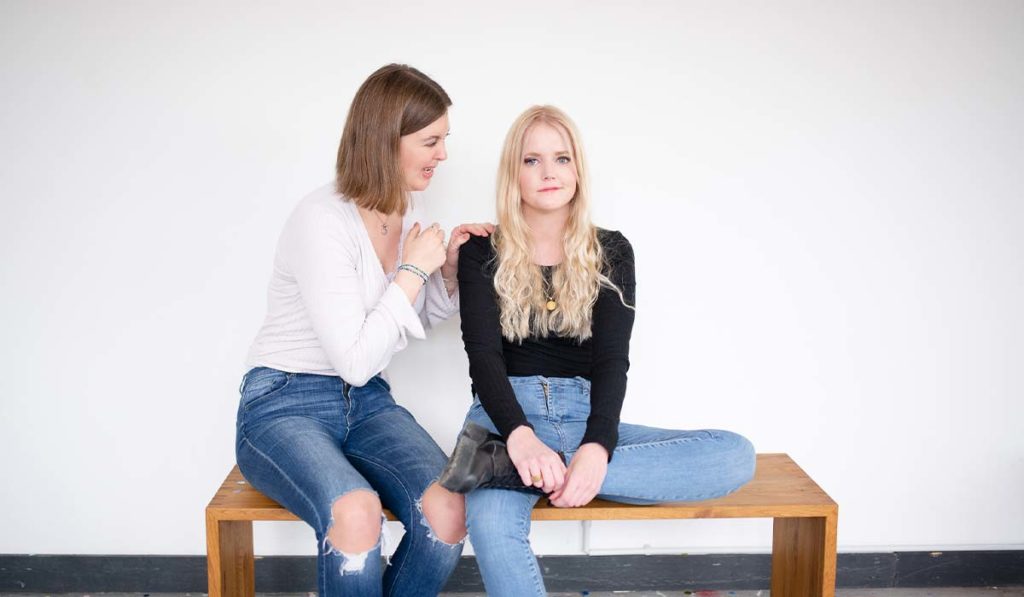
Greta and Larissa – Spokespersons for the “Life Deserves to Be Heard!” campaign
Greta and Larissa, who are friends, have been using brainstem implants for several years. For the “Life Belongs to Hearing!” campaign, they talk in an interview about their experiences with hearing aids and brainstem implants.
It's great that you're taking part in our campaign, "Life Deserves to Be Heard!" Greta, you have a brainstem implant. How did that come about?
I have neurofibromatosis type 2 (NF2). This condition is characterized by tumors that can grow anywhere in the nervous system, including on the auditory nerves. When I was 12, as these tumors grew, my hearing began to deteriorate, and I quickly got my first hearing aids. At the time, I grieved over the loss of my hearing with every frequency that worsened, yet at the same time, I couldn’t identify as hard of hearing.
Larissa, what's your story?
I have two brainstem implants; the first one was implanted in 2014. Shortly after my NF2 diagnosis, I began to notice the first signs of hearing loss. I was in the hospital at the time and couldn’t understand the night nurse. That was a frightening moment. I knew about my tumors on the auditory nerves, but I was still surprised at how quickly it happened.
So, does that mean your hearing loss was initially treated with hearing aids?
Greta: For many years, I had two medium-sized hearing aids that were with me throughout my school years and my life. My friends accepted this situation right from the start, tried to make things easier for me, and didn’t ignore my hearing aids. That helped me a lot and was amazing!
Larissa: I could still hear well in one ear for a very long time. It wasn’t until 2017, when my residual hearing also began to deteriorate, that I started using my hearing aids full-time. I was already working at the time, and on some days they helped me communicate well, while on others they were less helpful. I experienced several episodes of sudden hearing loss during that time. My hearing aids couldn’t compensate for the problems with the frequencies, and I could no longer follow conversations.
Larissa, I'm sure the decision to get a brainstem implant wasn't an easy one for you, was it?
I got my first implant when I could still hear well in one ear. My hearing was out of sync between my two ears, and my implants gave me headaches and nausea. I also had a harder time understanding what people were saying when I was wearing the implant. That’s why I didn’t use it very often. It wasn’t until I went deaf after surgery in 2018 that I put it on, and my sister asked if I could understand her. I was able to say yes. I could understand speech right away—something no one thought was possible with an ABI back then. I was overjoyed.
Greta, you had a musical "aha" moment, right?
Before I received the brainstem implants, my treating physician couldn’t tell me exactly what I would be able to hear again or how well. He said that I should be able to recognize sounds, but when it came to understanding speech and listening to music, it wasn’t clear whether I would be able to perceive them or how well. When my implants unexpectedly worked so well that I could understand speech, I tested to see if I could hear my favorite songs again. That was a moment when I wanted to stop time, because yes, I could hear them, and so many memories came flooding back.
What prejudices about hearing aids and brainstem implants have you had to deal with, or are you currently dealing with?
Greta: Even with a hearing aid or an implant, the hearing loss is still there. I often get the feeling that people think I can hear perfectly normally again with my hearing aid. No, that’s not the case. I still rely on lip-reading, have to ask people to repeat themselves quite often, and background noise is a real struggle.
Larissa: I agree with Greta on this. People I know have also asked me why I can’t just use a phone. After all, I have implants. Plus, people still feel embarrassed about relying on hearing aids or implants. The switch from hearing aids to implants is particularly difficult for many because implants are slightly larger and therefore more visible.
With the goal of raising awareness about good hearing, the German Hearing Aid Industry Association (BVHI) has launched the campaign“Life Is Worth Hearing!” You’ll learn how to preserve your hearing for the long term and, if necessary, get the best possible care. The Hearing Ambassadors support this effort and help motivate people to have their hearing checked regularly and, in the event of hearing loss, to seek professional help in a timely manner.
Larissa, what talent have you developed as a result of wearing the brainstem implants?
We often have video conferences at work. Unlike with phone calls, I don't have any problems with them. With my implants, I can tell exactly when someone's headset isn't working or isn't turned on.
And you, Greta?
I realize very quickly when I need a break from listening because my mind is overwhelmed. I wasn’t very good at that before, but now I’m able to set boundaries very well as a result. Sometimes I like to take advantage of the fact that I’m both deaf and hearing. That means that when I don’t feel like listening, I just take out my implants.
How can we encourage people to talk more openly about hearing health?
Larissa: Social media, in particular, is a great platform for raising awareness about taboo topics. We often notice that people are interested in these topics and tentatively dare to ask questions.
Greta: Hearing problems can affect any one of us. Whether it’s tinnitus caused by a stressful job or hearing loss, it’s not something that should be considered taboo. The more openly we talk about it, the better we can support and empower one another.
Larissa, what unexpected experience did you have while wearing the implants?
We became listening mentors for MED-EL. Not only have we met many cochlear implant users, but this also allows us to help people who are still unsure about getting an implant.
How do brainstem and cochlear implants differ?
With a brainstem implant, electrical stimulation occurs in the inner ear; with a cochlear implant, the stimulation electrode is positioned in the cochlear nucleus complex. The sound processors for both solutions are worn behind the ear. The main difference lies in the shape of the electrode array. Learn more about cochlear implants.