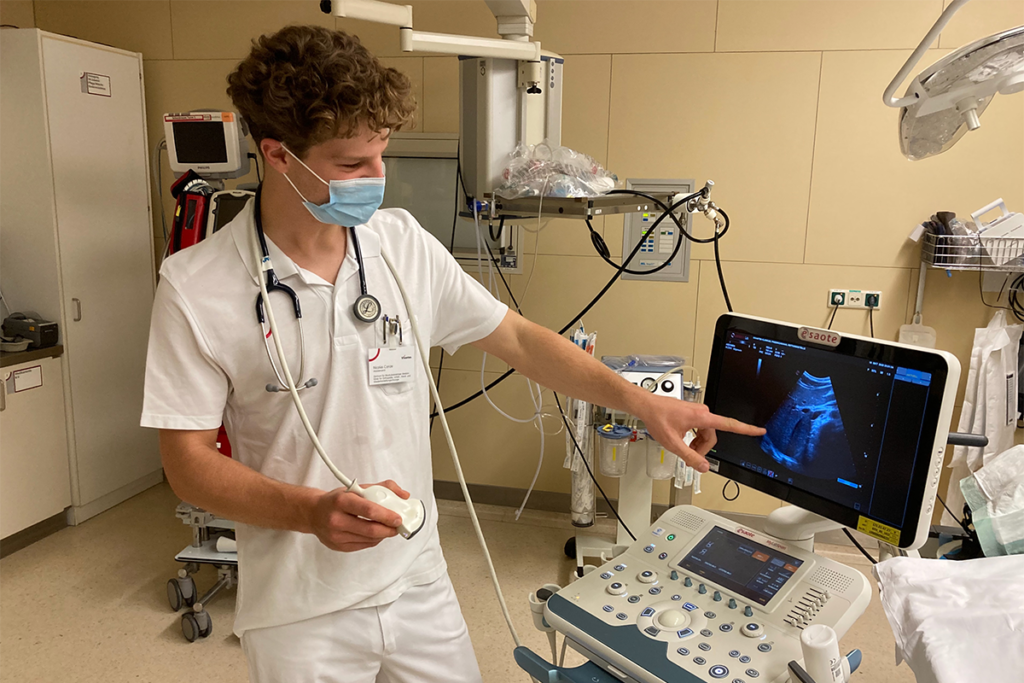
A doctor with a cochlear implant
"My cochlear implant has become a part of my life," says resident physician Nicolas. How a doctor with a cochlear implant (CI) works and why early implantation makes sense.
As a teenager, Nicolas from Berlin suffered from unilateral hearing loss. “When I was 15 years old, I woke up one morning and realized that I could hear so poorly in my right ear, it was as if I were standing behind a soundproof wall. I went to see an ENT doctor right away. Then came the full course of treatment: an ENT clinic, cortisone therapy, inner-ear surgery, and a conventional hearing aid.” Later, Nicolas received a special CROS hearing aid, which can enable spatial hearing despite unilateral deafness. In this system, the receiver and microphone are decoupled and placed in different locations. This allows sound to be picked up by one ear and transmitted to the other. Very soon, the doctors recommended that Nicolas undergo cochlear implantation due to his unilateral hearing loss. Several in-depth consultations followed. Yet for nearly ten years, Nicolas put off getting a cochlear implant for his right ear.
Who is a good candidate for cochlear implants?
Even young children, adults, and seniors can benefit from hearing implants.
Cochlear implants are suitable for:
- children born deaf or who lost their hearing at an early age
- children with profound hearing loss
- Adults with severe hearing loss or deafness in one or both ears
- People who can no longer achieve sufficient speech comprehension even with an optimally fitted hearing aid
A key requirement for a cochlear implant is a functioning auditory nerve. Patients should also be motivated to undergo hearing training and willing to attend regular follow-up appointments.
Finding the Courage for a Cochlear Implant
Nicolas expected that, at best, he would only be able to hear sounds with the CI. That was one reason he kept putting off the CI implantation. Ultimately, it was his girlfriend who gave him the push he needed. She encouraged him and helped him overcome his fear of the CI surgery.
Extensive preoperative examinations and consultations take place before a cochlear implant (CI) surgery. This includes a CT scan to assess the condition of the cochlea. During the surgery, which typically lasts one to three hours, the implant and electrode array are inserted under general anesthesia. For this routine procedure, an incision is made behind the outer ear and slightly above it, and the implant is then inserted using a minimally invasive technique. Next, a recess is usually milled into the bone, and the electronic component of the CI is placed inside it. Next, an opening is created in the middle ear to insert the electrode into the cochlea. As the final step of the CI surgery, the doctors test the cochlear implant and stimulate the auditory nerve for the first time.
About four to six weeks after surgery, CI technicians activate the cochlear implant’s audio processor for the first time. Patients then experience their first auditory impressions. The subsequent outpatient or inpatient hearing training teaches patients how to hear with a CI and is often a crucial step toward successful hearing.
A Doctor with a Cochlear Implant
Fortunately, Nicolas’s expectations were far exceeded. His spatial hearing has improved significantly thanks to the CI. This is a major advantage in everyday life and especially in his profession as a resident in trauma surgery and orthopedics. “Especially in the operating room, I need to be able to hear from both sides and listen without turning my head. I can do that much better now with my cochlear implant,” he says. “Understanding speech in noisy environments, or when someone speaks to me from the right, is also much easier.” Not only can he listen to podcasts, which he streams directly to his CI audio processor, but Nicolas also has his own podcast. “Sprechzimmer” is all about the healthcare system from the perspective of young medical professionals.

“Through independent hearing training and determination, I can personally contribute a great deal to my success. My cochlear implant has become a part of my life. I wouldn’t want to be without it,” says Nicolas, a resident physician. “My hearing loss is no longer an obstacle to pursuing and achieving my professional or personal goals.” In his free time, the doctor with a cochlear implant enjoys meeting friends, playing sports, and sailing; he loves to travel, produce podcasts, and listen to music.
Advice for Potential CI Users
Nicolas wants to encourage everyone in a similar situation to use cochlear implants or other hearing implants. While it is possible to live with just one ear, for example, the doctor with a cochlear implant is certain: “A cochlear implant restores a great deal of quality of life and the joy of communication.” He admits he hesitated for too long himself. However, his concerns about the risks of surgery and wearing an audio processor turned out to be unfounded.
Read here about an ENT doctorwho has cochlear implants and understands the lives of her patients with hearing loss from her own experience.

The History of the Cochlear Implant
The cochlear implant (CI) is a global success story. Click now to learn more!

10 Myths About Hearing Implants You Can Safely Forget
When hearing aids alone aren’t enough, cochlear implants can be an ideal solution. We debunk the myths about cochlear implants.

Being Open About Hearing Loss and Cochlear Implants
Stefanie from Berlin is open about her hearing loss—she even lets people touch and try out her audio processor.