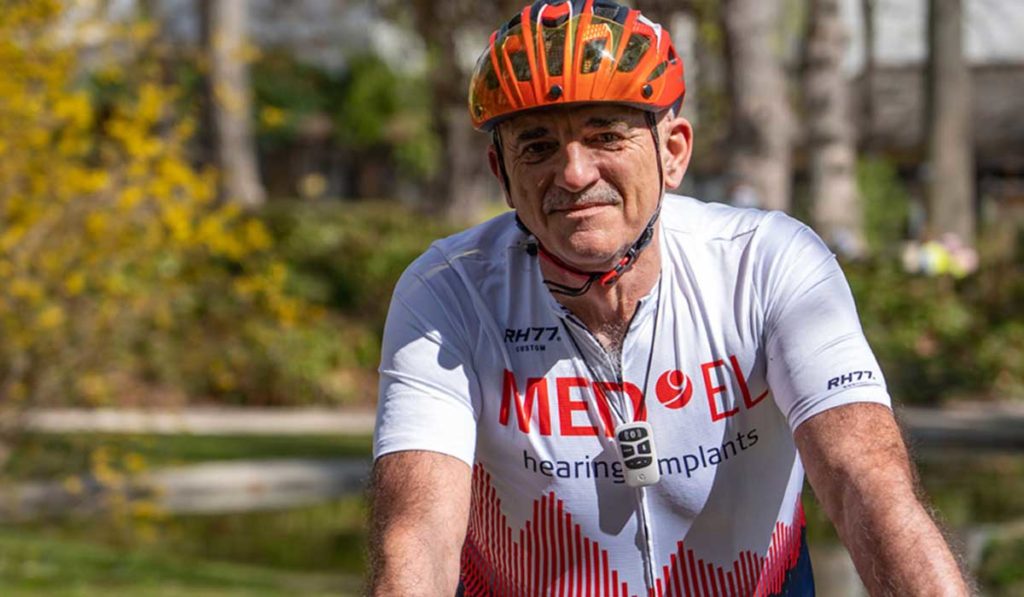
The right bike helmet ensures safety and an enjoyable listening experience while riding on the road
For active cochlear implant users, safety plays a crucial role. This is because reliable hearing is essential, especially during outdoor activities such as biking. Cycling with cochlear implants is no problem at all. However, to ensure hearing performance isn’t compromised, choosing the right helmet is essential.
Cycling with cochlear implants is a lot of fun, as 66-year-old Max Sailer can attest. He is an avid cyclist and has been using cochlear implants (CI) since February 2021. Of course, he uses them while biking as well, since good hearing is essential when out on the road.
“I feel safer in traffic with my cochlear implants because I can hear cars, horns, audible traffic signals, and other people,” says Max Sailer. “I can also easily chat with friends and acquaintances while we’re riding on long bike trips. Plus, I can enjoy my favorite sound—the sound of shifting gears while biking.”
Every Sound Is a Gift – The Path Back to Hearing with a Cochlear Implant
The 66-year-old’s hearing loss is hereditary. On his mother’s side of the family, all members—except for one cousin—wear hearing aids. Max Sailer’s hearing has progressively worsened since he turned 30. He even had to give up his job as an anesthesiology technician at the hospital because hearing aids didn’t help him at the time.
His hearing loss became a particular problem during surgeries, as he could no longer hear important information or the sounds of medical equipment. His ENT doctor recommended at the time that he get cochlear implants.
In the spring of 2022, a CI was also implanted on the left side; since then, he has been able to hear equally well on both sides, including spatial hearing. From the very beginning, Max Sailer knew he would have to train his hearing with the CIs. “I wore—and still wear—my audio processors as often as possible, and I look forward to putting them on every morning,” he adds. “Also, I was never afraid to ask strangers when I heard a sound I couldn’t immediately identify.”
Cycling with a cochlear implant—greater safety on the road
The fact that cycling is perfectly possible with cochlear implants is also demonstrated by the approximately 4,000-kilometer bike trip that Max Sailer undertook in the summer of 2022 through Austria, Germany, and Switzerland: From his home near Gleisdorf, he cycled via Graz, Salzburg, Munich, Hanover, Bremen, and Hamburg all the way to Cuxhaven.

His goal: to hear the sound of the North Sea. On his way back, he passed through Strasbourg, Bregenz, Lake Starnberg, Innsbruck, Villach, Klagenfurt, and Marburg, among other places.
Road safety is very important when cycling with a cochlear implant—every single time you ride. To protect himself in the event of a fall, Max Sailer always wears a helmet when cycling with cochlear implants. This not only protects his head but also prevents damage to his audio processors—without compromising his hearing.
Tips for Choosing the Right Helmet
When choosing a helmet, people with cochlear implants should keep a few things in mind:
- The helmet must fit snugly and not slip, because that’s the only way it can protect your head—and the audio processors—in the event of a fall.
- To ensure the audio processors fit comfortably under the helmet, the helmet should have generous cutouts around the ears or in the area where the audio processors are located.
- Since heads vary in shape and audio processors aren’t always positioned in the same spot, it’s not possible to recommend a specific helmet across the board—everyone should find the helmet that fits them best by trying on different models and seeking expert advice.
By the way, this applies not only to bicycle helmets, but also to all other types of helmets.
Hear more with every kilometer
“I recommend that other active CI users not be afraid to wear their audio processors while exercising,” says Max Sailer. “They give wearers a sense of security, and they can enjoy every sound in their surroundings. Even if it takes a little longer to find the right helmet, it’s worth it.”
The 66-year-old has now been on several cycling trips and has ridden his bike for several thousand kilometers with cochlear implants. “I can hear that clicking sound again when the chain shifts to the next sprocket. I hear the children cheering behind the house and the birds chirping. I hear it when I ride through a pile of leaves. And I hear the water splashing when I ride through a puddle. Not to mention cars,” he says happily.
With cochlear implants (CI), you can participate in many sports just as you normally would. However, there are a few things you should keep in mind. Read our article “Sports with a CI – Stay Active and Have Fun!” to learn how to stay active and properly protect your audio processors from moisture, dust, and sand.