Hear Better with Light and Electricity
Hearing with light could enable cochlear implant (CI) users to better distinguish between pitches in the future. This would make it easier to understand speech in noisy environments and allow them to enjoy music more.
At a Glance
- How Hearing with Light Works
- Playing the Piano While Wearing Boxing Gloves
- Optical CI with light-emitting diodes
- Better sound discrimination
Cochlear implants stimulate the auditory nerve of people with severe hearing loss or deafness using electrical current. However, people with a cochlear implant do not hear the same way as people with normal hearing. As a result, speech comprehension in noisy environments is poorer, and music perception is typically limited with cochlear implants.
Now, scientists have discovered that CI users can hear better with light and electricity. This is achieved by specifically stimulating the auditory nerve with light. Since light can be spatially localized more effectively than electrical current, the auditory nerve can be stimulated much more precisely.
How does hearing with light work?
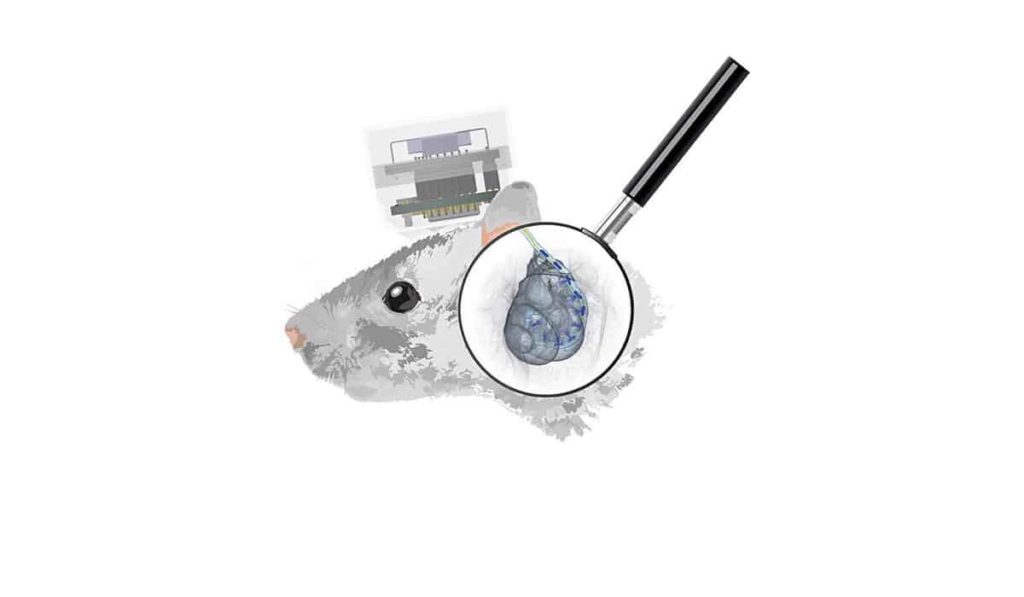
Naturally, the auditory nerve does not respond to light. Therefore, it is necessary to first make it light-sensitive through gene therapy in order to enable hearing with light. Scientists and physicians have now tested this for the first time in an animal model with a genetically modified, light-sensitive auditory nerve. Our cover image shows an optical cochlear implant in the cochlea of a rat, © Dr. Daniel Keppeler, University of Göttingen.
Similar to human hearing loss, can hearing be achieved using light via a novel optical cochlear implant? These cochlear implants, which are based on micro-LEDs, stimulate the genetically modified auditory nerve with light—and do so with great precision.
The animal model was developed in Göttingen at interdisciplinary biomedical research institutions. Here, the focus is on hearing, nerves, and the transition from molecular machines to biological networks of excitable cells. The corresponding optical cochlear implant was developed at the University of Freiburg.

Prof. Dr. Tobias Moser, director of the Institute for Auditory Neuroscience at the University Medical Center Göttingen and spokesperson for the Cluster of Excellence, is certain: “Thisis an important milestone in the development of future clinical optical cochlear implants.”
Stimulation of the auditory nerves or playing the piano while wearing boxing gloves
More than 700,000 people worldwide with severe to profound hearing loss or deafness can now hear again thanks to a cochlear implant (CI). So far, the auditory nerve has been stimulated using electrical impulses. However, the quality of this artificial hearing differs greatly from natural hearing. Due to widespread electrical propagation in the cochlea, large groups of nerve cells are activated instead of smaller, more targeted groups.
This is roughly comparable to playing the piano with boxing gloves instead of using individual fingers. As a result, while CI users can communicate very well in one-on-one conversations, they have difficulty understanding speech when there is a lot of background noise or multiple speakers. In such cases, they sometimes have to rely on gestures and facial expressions or read lips. In addition, the ability to enjoy music is often limited with a CI.
First Optical Cochlear Implant with Micro-LEDs
In previous studies, a maximum of three optical fibers was always used to optically stimulate the auditory nerve and guide light from external lasers into the cochlea. Current research is breaking new ground. For the first time, it uses optical CIs with 16 µLEDs (micro-light-emitting diodes) and an edge length of 0.06 millimeters to stimulate the auditory nerve of desert mice.
The advantage:
Cochlear implants with these tiny micro-light-emitting diodes are capable of generating light independently at different locations within the cochlea. This makes it possible to stimulate the genetically modified auditory nerve using these special µLED cochlear implants. CI recipients then hear using light.
Improved Sound Discrimination Possible
“The integration of miniaturized light emitters—with dimensions equivalent to the thickness of a human hair—into a flexible cochlear implant for the small cochlea of rodents is a technical masterpiece by our colleagues in Freiburg,” says Prof. Dr. Tobias Moser. Hearing with light enables very high precision in stimulating the auditory pathway.
That is why such a cochlear implant allows for better sound discrimination. “Even though the development of optical cochlear implants for humans will still take several years, current experiments already demonstrate improved pitch resolution compared to electrical cochlear implants.”
Read here to find out how deaf mice can hear again thanks to gene therapy.