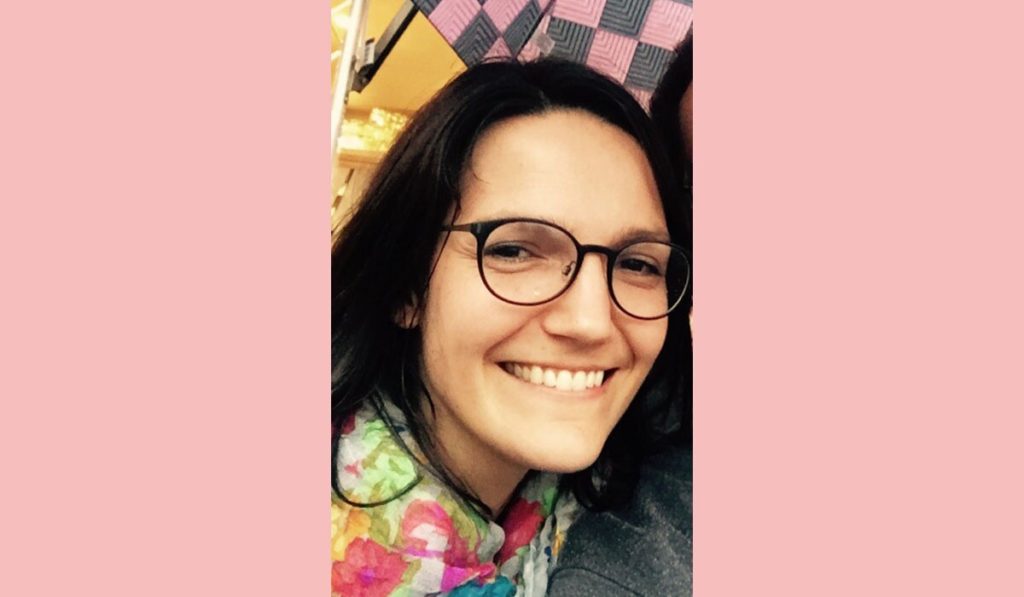
Scientist and Mother with a Cochlear Implant
Dr. Valerie Pestinger is a molecular biologist specializing in cancer research and lives in Hamburg with her husband. She has had cochlear implants (CI) in both ears since 2016—and is the mother of a young daughter.
At a Glance
- Graduating from college with hearing aids
- Hearing Again Thanks to Cochlear Implants
- Mother with a cochlear implant
What is a cochlear implant?
A cochlear implant is a medical device that restores hearing function. Unlike a hearing aid, which amplifies sound, a cochlear implant bypasses the damaged, non-functioning part of the inner ear. Patients with sensorineural hearing loss—whose hair cells in the cochlea, the spiral-shaped structure in the inner ear, are missing or damaged—can hear again with a cochlear implant and actively participate in life.
“I have to keep reminding myself that many of the things I now take for granted aren’t something to be taken for granted,” says Dr. Valerie Pestinger, a mother who has cochlear implants. For her, this includes, for example, the click of a ballpoint pen or—much more importantly—hearing her child’s heartbeat. “It was an indescribable experience—even the birth—when I heard my child’s cry for the first time.” A molecular biologist with a Ph.D., she contracted a severe form of meningitis at the age of four, which was initially mistaken for the flu. By the time the doctors realized it was meningitis and not the flu, Valerie Pestinger was already deaf in her right ear and had hearing loss in her left ear.
Graduating from College with Hearing Aids
Valerie Pestinger was then fitted with a hearing aid for her left ear, and her parents supported her as best they could. Despite her hearing loss, Valerie Pestinger attended a regular high school and grew up quite naturally among hearing peers. Later, during her college years, she was successful despite her hearing loss. At the university, she met her husband, who, like Valerie Pestinger, was a doctoral candidate. At that time, the scientist suffered a sudden hearing loss, causing her hearing in her left ear to deteriorate significantly. “Of course, I clung to what little hearing I had left. I didn’t want to admit that I was hearing less and less,” Valerie Pestinger explains, describing the progression of her hearing loss. “I could only understand my colleagues in bits and pieces; I could no longer make phone calls; I had to ask my boyfriend or my parents for everything; working became impossible for me. I had no other option left but cochlear implants.”
Although the scientist had known since her youth about the possibility of getting cochlear implants, she had not wanted to undergo surgery until then. As long as her hearing in her other ear remained stable, she shied away from the surgery. What proved helpful was meeting a woman in her father’s circle of friends who had cochlear implants in both ears. “She encouraged me in my decision—that was good and important. Because until then, I hadn’t had any contact with other cochlear implant users, which, in hindsight, was a mistake,” said the young mother.
What does cochlear implant surgery involve?
For CI implantation, an incision is made behind the outer ear and—depending on the type of cochlear implant—a small one slightly above the tip of the outer ear. The surgeon inserts the cochlear implant under the skin. To do this, he drills a recess into the bone behind the ear toward the back of the head. The electronic component of the CI is placed into this recess. Next, a channel is drilled into the bone from the back, and an opening is created in the middle ear to insert the electrode into the cochlea. As the final step of the CI surgery, the doctors test the cochlear implant and stimulate the auditory nerve for the first time.
Hearing Again Thanks to a Cochlear Implant
Valerie Pestinger decided to have cochlear implants fitted in both ears at the same time. “Just a few days after the surgery, the CIs were activated. Suddenly, I could have conversations again and even heard a pen click. It was incredible,” Valerie Pestinger recalls with joy even today. “Right after the processors were turned on, I practiced using apps and music programs on my cell phone. Even after rehab, I continued to practice on my own using hearing programs and audiobooks.” And it paid off—today, with her cochlear implants, this mother is once again able to handle her daily life and career with ease. This includes making phone calls and participating in group discussions.
A Mom with a Cochlear Implant—Just Like Any Other Mom
In 2019, Pestinger had a baby girl. Pestinger never feared being a mother with cochlear implants or having a child with hearing loss: “Apart from the fact that there’s no genetic predisposition to deafness in either of our families and I lost my hearing myself due to an illness, I know exactly what I would do if my daughter were to suffer from hearing loss: She would get cochlear implants right away. The most important thing is that language develops normally. I was always told that I was lucky to already be able to speak when I lost most of my hearing. “Waiting would be out of the question for me.” And to prevent her daughter from contracting meningitis, she was vaccinated immediately after birth, because that’s possible today—unlike in the 1980s.
In addition, Valerie Pestinger is very relaxed when it comes to the challenges she faces. These include, for example, using assistive technology. There are quite a few products on the market for cochlear implant users, but not for mothers with cochlear implants—with one exception: “The only thing that’s really special is the baby monitor,” says the mother with a cochlear implant, who otherwise faces the same challenges as any other mom.