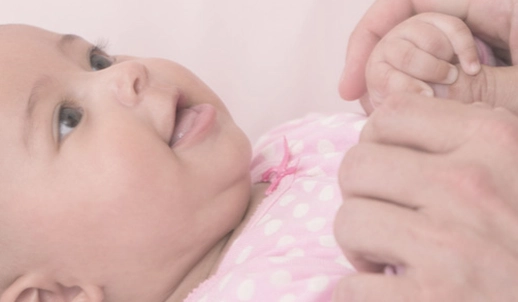
Infants learn their native language during the first few months
After birth, babies primarily make sense of situations and events by listening to sounds, since language comprehension develops only gradually. Even though babies do not yet understand the content of speech, they can still tell from the tone of voice whether Mom or Dad is telling a funny story, or they calm down when they hear a familiar voice. A research team at the University of Konstanz has now discovered that infants can distinguish between many speech sounds as early as the first few months of life.
For new parents, there’s hardly anything more wonderful than the moment their child calls them “Mama” or “Papa” for the first time. By that point, however, the child has already learned quite a bit, as a research group at the Baby Language Lab at the University of Konstanz has discovered. The scientists led by Bettina Braun, a professor in the Department of Linguistics, have observed more than 1,000 children since the lab was founded in 2007. They have concluded that infants can already distinguish many of the approximately 800 sounds found in all the world’s languages within the first few months of life. A few months later, they focus on the sounds that are important in their native language. For example, Japanese babies then realize that “l” and “r” are not crucial for them and no longer perceive the difference. Then the little ones begin to perceive sequences of sounds as words. It helps that they are already familiar with the rhythm, stress patterns, and intonation of their native language. Therefore, the intonation and stress patterns present in the language parents use to speak with them play a major role.
Only those who listen can learn to speak
Good hearing is the foundation for all of these important observations. Therefore, it is crucial for language acquisition that parents pay attention to their children’s hearing from the very beginning. This includes, among other things, having their newborn undergo hearing screening in the first few days of life so that any hearing problems can be detected and treated before they delay language acquisition. Since babies cannot yet indicate on their own that they cannot hear or hear poorly, parents need to be especially attentive if, for example, they notice that the baby does not turn toward them when they speak to it. Especially with young children, it’s also crucial that hearing loss isn’t addressed solely with hearing aids. Speech therapy provides additional support for children with hearing impairments and their parents and contributes to healthy language development.
Do you suspect that your child has difficulty hearing? Here, we’ve compiled all the important information on how to recognize hearing lossearly, what you can do about it, and where to get help.
See how good hearing works

Hearing Loss Explained Simply

How is a hearing test conducted?

How do you put on a behind-the-ear (BTE) hearing aid?

Teaser Video Series: Tips & Tricks for People with Hearing Loss

How can you learn to listen properly?

How often do you take a hearing test?

A Flight Through the Ear: Hearing Explained Simply

Hearing Protection for Musicians

Listen. The Meaning of Your Life