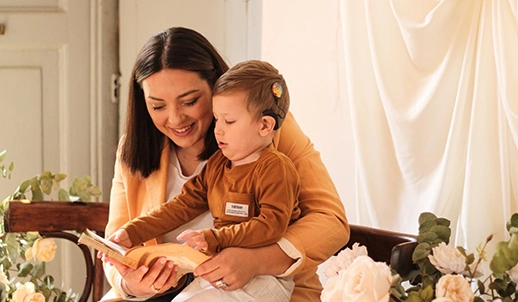
When a baby fails the newborn hearing screening, everything is turned upside down for many parents from one moment to the next. That’s exactly what happened to Riccardo’s family. Shortly after his birth, they embarked on a journey filled with questions, worries, and important decisions.
From a CMV Diagnosis to the World of Sound
Riccardo’s story begins shortly after his birth in 2022. He was born prematurely and was flagged during the newborn hearing screening because he failed the hearing test on one side. After further testing, his family received a diagnosis of congenital cytomegalovirus (CMV) infection. This came as a great shock to his parents, as they had never heard of this infection before. Added to this was the concern that Riccardo’s hearing would continue to deteriorate despite early treatment.
At first, Riccardo was fitted with hearing aids, but over time, these were no longer sufficient. When he was eleven months old, his family therefore decided on a cochlear implant to give him access to hearing and speech as early as possible.
The cochlear implant surgery in 2023 was emotionally very difficult for his parents, but at the same time it was an important step filled with hope. One month later, the implant was activated. From then on, Riccardo and his family embarked on an intensive period of speech therapy, hearing training, and a great deal of support in everyday life. Step by step, Riccardo learned to respond to sounds, produce sounds, and say his first words. A year after his first implant, he received a second cochlear implant.
Today, his family describes him as a cheerful child who experiences music, voices, and everyday sounds with great joy. His story powerfully illustrates how important early diagnosis, close support, and a great deal of patience can be on the journey to hearing. Read Riccardo’s full story here.


What is a congenital CMV infection?
Cytomegalovirus (CMV) is a very common virus. Many adults are unaware that they are carriers of the virus. If the virus is transmitted to the unborn child during pregnancy, it can lead to a congenital CMV infection.
How is CMV related to hearing loss?
In some children, a congenital CMV infection can damage the inner ear. Hearing loss may be apparent immediately after birth, or hearing may deteriorate over time. This is exactly what happened to Riccardo’s family: Despite early treatment, his hearing continued to decline in both ears.
Why Early Action Is So Important
Hearing is important for babies and toddlers tolearn language and interact with others. When hearing loss is detected early, families and professionals can respond more quickly, and children have the opportunity to develop at a level appropriate for their age. Riccardo’s story shows how crucial early screenings, appropriate care, and regular support can be.
What Parents Should Know About Hearing Screenings
Riccardo failed the newborn hearing screening in his right ear. An abnormal hearing screening result does not constitute a definitive diagnosis. However, it is a clear indication that further testing should be conducted promptly at a specialized facility.
You can learn more about newborn hearing screening here.
What Parents Often Worry About
After receiving a CMV diagnosis, many parents wonder how to recognize hearing loss, whether hearing aids are sufficient, when a cochlear implant might be an option, and how well speech will develop later on. The journey is often emotionally taxing.
The Biggest Challenges on the Path to Care
- A diagnosis of congenital CMV infection comes as a surprise to many families and triggers fear and uncertainty.
- Hearing loss can continue to worsen despite early treatment, making quick decisions necessary.
- Parents must weigh whether hearing aids are still sufficient or whether a cochlear implant is the next logical step.
- Once the implant is in place, the next major phase begins: learning to hear, language development, and daily practice as part of family life.
These measures can help children from an early age
- Take an abnormal newborn hearing screening result seriously and have the recommended follow-up tests performed promptly.
- Have your child undergo regular pediatric audiological evaluations, especially if CMV-related hearing loss is known or suspected.
- Discuss with your ENT team early on whether hearing aids are still providing sufficient benefit or whether the use of a cochlear implant should be considered.
- Be prepared for the fact that patience is required after cochlear implantation. The initial fitting does not take place on the day of surgery, but only after the healing phase.
- Take advantage of speech therapy, hearing training, and simple repetitions in everyday life. Even small, daily exercises can make a big difference.
- Talk to other families going through the same experience. Riccardo’s parents found this support to be a great help.
Hearing aids or cochlear implants—what's the difference?
Hearing aids amplify sound. They can be helpful if there is still sufficient hearing remaining. If that is no longer enough, a cochlear implant may be an option. It partially bypasses damaged structures in the inner ear by directly stimulating the auditory nerve in the cochlea. In this way, the CI enables new auditory stimuli. For Riccardo, hearing aids helped at first, but later they were no longer sufficient.
Costs of a Cochlear Implant: Coverage by Health Insurance
Statutory health insurance generally covers the costs of a cochlear implant when medically necessary. This includes not only the implant itself and the surgery, but also diagnostic testing, hospital treatment, the initial fitting of the speech processor, and key aspects of follow-up care and rehabilitation. This provides significant relief for parents, as it means that access to care should not, in principle, be hindered by cost. However, affected families should always clarify exactly which services will be covered in their specific case directly with the treating clinic and their health insurance provider.
You can learn more about this in our article “Costs of a Hearing Implant.”
A wealth of expert knowledge
When a child has hearing loss, several specialists usually work together. These include ENT doctors, pediatric audiologists, audiologists, therapists, and—in cases involving hearing aids—hearing aid specialists. They assist with examinations, device adjustments, and the child’s ongoing development.
Why Follow-Up Care Is So Important
Riccardo’s progress wasn’t due solely to the cochlear implant surgery. Regular follow-up care, stimulation, therapy, and daily practice at home were also crucial. Checkups are especially important for children with CMV-related hearing loss because their hearing can change repeatedly over time.
If a newborn hearing screening indicates a problem or hearing loss is suspected, parents should contact an ENT specialist, a pediatric audiology clinic, or a cochlear implant center. Audiologists can also be important points of contact for further care.
Early diagnosis and prompt treatment
Riccardo’s story is inspiring. What began as a distressing diagnosis turned into a path into the world of sound thanks to early intervention, a great deal of patience, and close support. A cochlear implant following a CMV diagnosis can open up new opportunities for children to hear, speak, and participate in life.
If you suspect your child has a hearing loss or are looking for guidance after an abnormal screening result, consult an ENT specialist or a pediatric audiology center as soon as possible to determine the next steps. Additionally, finding a hearing aid specialist in Germany can be helpful if hearing aids or further consultation are needed.
See how good hearing works

Tips & Tricks for Living with Hearing Loss — Episode 1: Talking Openly About Hearing Loss

Tips & Tricks for People with Hearing Loss — Episode 2: All the Things a T-Coil Can Do

Teaser Video Series: Tips & Tricks for People with Hearing Loss

Tips & Tricks for People with Hearing Loss — Episode 3: Improving Room Acoustics

Tips & Tricks for People with Hearing Loss — Episode 4: Saying What You Need