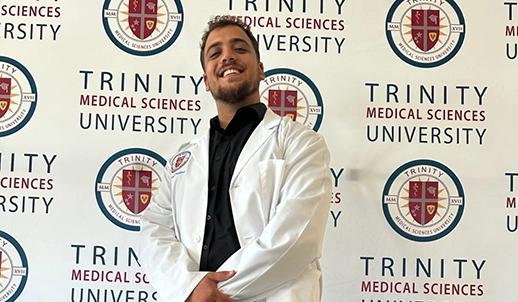
Today, Karam is studying medicine in the United States. Between his childhood and his life today, he has had to overcome numerous challenges related to hearing, rehabilitation, and inclusion. His story explains how these experiences led him to his dream job and what role his cochlear implant plays in that journey.

The moment Karam's world changed
Even as a small child, Karam reacted differently to sounds than other children. His parents noticed early on that something was wrong. Their initial concern soon turned into certainty: Karam had severe hearing loss. For his family, this marked the beginning of the search for a hearing solution that could make speech and sounds more accessible to him.
At first, Karam tried traditional hearing aids. Although they allowed him to hear significantly more, speech remained difficult for him to understand. Much of what his parents said to him sounded muffled and came across as unclear. For a child his age, this meant, above all, significant limitations in social and language development, as well as in learning through auditory stimuli.
By the age of four, Karam had reached a point where his existing hearing aids could no longer provide sufficient improvement. His parents therefore consulted with specialists on several occasions and explored the possibility of a cochlear implant in depth. The decision was a difficult one for them, because despite all their efforts, many questions remained unanswered. At the same time, they hoped to give Karam better access to spoken language and thus open up new possibilities for his communicative development. Ultimately, they decided to proceed with the implantation.
After the surgery and the subsequent recovery period came the moment Karam still remembers to this day: the first activation of his cochlear implant.
Suddenly, there were sounds that had previously been almost entirely absent from his world: running water, birdsong, footsteps, and, above all, the clear voices of his parents. “At first, it took a lot of getting used to. It took time, patience, and ongoing rehabilitation,” says Karam.
Step by Step Toward a New Daily Hearing Routine
Now the real work began. Karam had to learn to make sense of the new sounds and understand speech with increasing confidence. With every step forward, his daily life changed noticeably for the better. He was able to follow conversations more easily, participate more actively, and be more aware of his surroundings. At school, too, Karam found it increasingly easier to follow lessons, participate in discussions, and learn alongside his classmates. At home, he could hear his family’s laughter, understand jokes better, and engage more fully in conversations.
At the same time, his self-confidence grew, even though he initially found it difficult to adapt to some new listening situations, such as during sports. Karam, however, did not let that hold him back. He played with friends, learned to swim, and took up boxing. “My cochlear implant isn’t a barrier—it gives me strength and self-confidence,” he says, describing his hearing solution today.
From the First CI to the Next Generation
Over the years, it wasn’t just Karam’s hearing that evolved. The technology that supported him in his daily life also changed. As Karam got older, he switched to the next generation of cochlear implants and later to a newer audio processor. “When I switched to the new generation of CIs, I noticed the difference right away. The audio processor was lighter, more comfortable to wear, and the sound quality was even better,” Karam says.

What is the RONDO 3?
The RONDO 3 is an audio processor for MED-EL cochlear implant systems. Unlike traditional behind-the-ear processors, this compact device sits on the side of the head and combines all essential components in a single housing.
Two microphones pick up sound from the surroundings. Automatic Sound Management 3.0 automatically adjusts the settings to different listening situations. The built-in rechargeable battery can be charged wirelessly.
For music, phone calls, and other audio signals, the RONDO 3 can be connected to compatible smartphones or tablets via the AudioStream Adapter. Users can check settings and battery level using the AudioKey 3 app, among other features.
The RONDO 3 is IP68-rated for water resistance and comes with various covers for customization.

Technical features also play an important role in Karam’s daily life today. Whether in lectures, at a café, or on the go, he uses his cochlear implant in a wide variety of listening situations. He particularly appreciates the wireless connectivity options, which allow him to stream video calls or other audio signals directly via the AudioStream adapter.
The accompanying smartphone app has also become an integral part of his life. He uses it to easily adjust all settings and keep an eye on the battery level at all times. His favorite feature, however, remains the Bluetooth connection.
Why Karam Wants to Become a Doctor
Despite all the challenges, Karam’s own experiences with his hearing loss and cochlear implantation have also had a positive side: they led him to his dream career. Today, he is studying medicine in the U.S. and hopes to specialize in cochlear implantation later on. For him, this goal is closely tied to his own personal experiences.
After all, he knows all too well how much can change when medical care, support, and the right technology come together. That’s why he wants to help people in the future who are facing decisions similar to those his family once faced. “I want to give others the same opportunity that I was given,” he explains.
Karam's Message to Other Families
In the end, Karam addresses families who are facing a similar journey. His message is shaped by his own experience and is deliberately personal: “There is hope for all families going through a similar journey.”
For Karam, the cochlear implant has opened up many new possibilities. At the same time, he emphasizes how important care, support, and perseverance are. Above all, his story shows how hearing care is experienced on an individual basis. Which solution is right for a person should always be discussed together with medical and audiological professionals.
Finding the right hearing solution requires personalized guidance
Karam’s experiences make it clear that personalized hearing care depends on a variety of factors, including an individual’s hearing ability and initial medical condition. A professional examination or an initial assessment by a hearing care professional can provide an important foundation for this. Use our free hearing care professional locator to find a hearing care professional near you. Our online hearing test also offers a first impression of your hearing ability. For a medical evaluation, you can use our ENT doctor finder.
See how good hearing works

Tips & Tricks for Living with Hearing Loss — Episode 1: Talking Openly About Hearing Loss

Tips & Tricks for People with Hearing Loss — Episode 2: All the Things a T-Coil Can Do

Teaser Video Series: Tips & Tricks for People with Hearing Loss

Tips & Tricks for People with Hearing Loss — Episode 3: Improving Room Acoustics

Tips & Tricks for People with Hearing Loss — Episode 4: Saying What You Need



