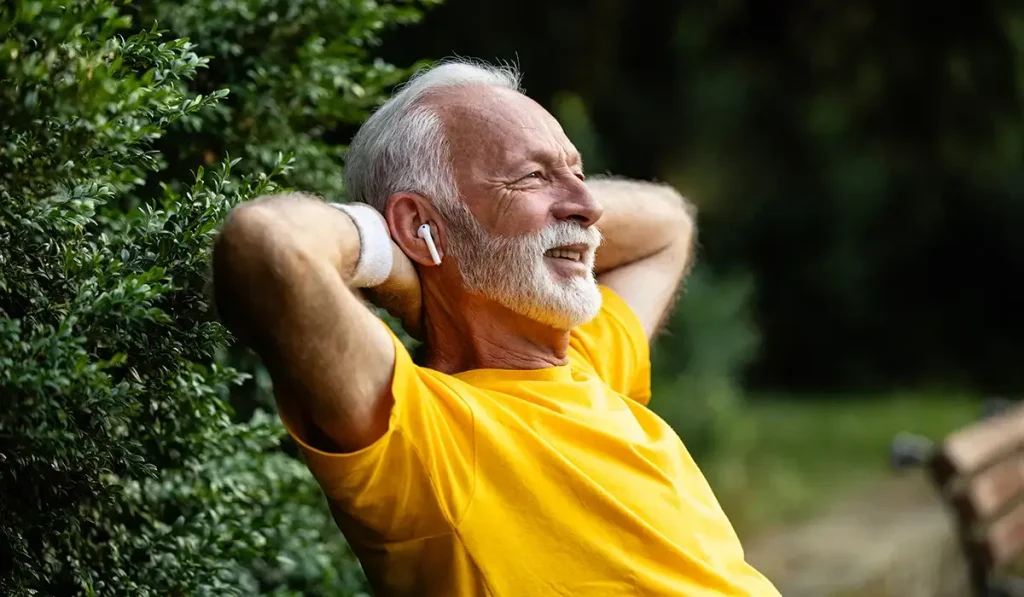
The new year has begun, and many of us have resolved to start it off on a healthy note. Often, this isn’t just about improving our health in the short term, but about maintaining it for as long as possible—in the spirit of longevity. People who want to age healthily usually think first of exercise, nutrition, and mental fitness, but hearing health is often missing from the list.
Yet longevity and hearing are closely linked: Good hearing plays a crucial role in staying mentally and physically fit, maintaining social connections, and being able to manage daily life independently—without help from others—for as long as possible. Among other things, intact spatial hearing helps us navigate urban environments safely. We’ll show you five longevity routines that will benefit both your hearing and your overall health.
What is longevity?
Longevity means “a long life.” What matters most is not the maximum length of life, but spending as many years as possible in good physical, mental, and social health.
Typical areas of longevity include:
- Healthy nutrition and supplementation (supplementing one’s diet)
- Sports and exercise
- Good sleep and low stress
- Prevention, such as through regular health checkups
- Technologies, such as those for tracking bodily functions
- Anti-aging research
- Good hearing is also a key factor in overall health.
People who take care of their hearing enjoy a better quality of life because they can fully participate in conversations, get-togethers with family and friends, and other activities. People who don't hear well often withdraw and lose out on social interaction.
Good hearing and healthy aging go hand in hand
Hearing is a key sensory system in our bodies. It influences orientation, cognitive function, attention, balance, and social participation—all of which are key factors affecting quality of life and mental health.
Many longevity rituals work only if sensory and bodily perception are intact. For this reason, many longevity routines are based on healthy hearing and good auditory processing. Conversely, longevity rituals that focus on hearing usually have a positive effect on the entire body.
Why We Must Not Neglect Our Sense of Hearing
Hearing is an early indicator of physical and mental health. The consequences of untreated hearing loss can have a wide range of negative effects, including frequent fatigue and listlessness, social isolation, loneliness, or mental distress, and even depression. In addition, studies have found an increased risk of heart failure and other cardiovascular diseases associated with hearing loss.
Additional studies (e.g., the Lancet Commission or Conceição Santos de Oliveira et al., 2023) also show that hearing loss is one of the greatest risk factors for accelerated cognitive decline—and, at the same time, one of the factors that can be most effectively addressed early on.
Five Longevity Routines for the Body, Mind, and Hearing
Those who preserve their hearing also strengthen their cognitive reserves and, in turn, their ability to age with mental health. With the following five simple routines, you can easily incorporate longevity rituals into your daily life and do something good for your hearing and your entire body:
- 5-Minute Silence Routine: Consciously exposing yourself to silence for five minutes and being fully present relieves strain on your auditory cells, calms your entire nervous system, and promotes mental relaxation.
- Everyday Volume Check: Headphones, street noise, electronic devices—what’s the current volume level around you? Noise not only stresses your hearing and can damage it, but also puts your entire body in an unhealthy state of stress. Be mindful of what you’re hearing and try to reduce the noise level.
- Regular hearing tests: Professional hearing tests conducted by hearing care professionals or ENT specialists should be on everyone’s health checklist. They are easily accessible, precise, and one of the most effective preventive measures against premature cognitive decline. Starting at age 50, you should have a hearing test every two years.
- Nutrition for Blood Vessels and Sensory Cells: A Mediterranean-style diet rich in vegetables, fruits, whole grains, legumes, fish, nuts, and healthy fats supports vascular health, including in the ear. It provides antioxidants, omega-3 fatty acids, magnesium, potassium, B vitamins, and zinc, all of which can have a positive effect on hearing.
- Exercise is good for your ears: Exercise promotes blood flow in the inner ear. The recommendation is: 150 minutes of moderate activity per week contribute to hearing health. Brisk walking or cycling improves blood flow all the way to the tiny blood vessels in the cochlea, thereby reducing the risk of age-related hearing loss. If you incorporate a little exercise into your daily routine every day—such as short walks—you’ll quickly reach the 150 minutes per week.
Act Quickly in Cases of Hearing Loss
If you notice that your hearing is declining or have already been diagnosed with early-stage hearing loss, early intervention is crucial. You shouldn’t wait several years. It becomes more difficult to get used to hearing aids and to the sounds of everyday life. Modern hearing systems restore your quality of life, make daily life easier, and help you remain active and independent.
Numerous recent studies have examined the link between untreated hearing loss and the decline in cognitive function, particularly perception, attention, memory, and the ability to learn and solve problems. The report by the international Lancet Commission, which examined the potential impact of untreated hearing loss in middle age on the later risk of dementia (Livingston et al. 2020), received widespread attention worldwide. The study does not identify a causal relationship.
Consistent use of modern hearing technology in combination with audiotherapy reduces stress, strengthens personal autonomy, and sustainably improves quality of life in older age.
Invest in healthy aging through hearing tests!
Those who protect their hearing early on, have it checked regularly, and seek consistent treatment when needed are actively investing in healthy aging. A professional hearing test is the most important first step. Regular hearing tests are especially recommended starting around age 50, particularly for people who are frequently exposed to noise or have a family history of hearing loss.
As experts in hearing health, hearing care professionals and ENT doctors can quickly and easily assess the state of your hearing and determine how changes in your hearing can be treated in a timely manner.
You can find practices and locations throughout Germany using the hearing specialist search or ENT doctor search on Ihr-Hoergeraet.de.
Longevity is a trend that’s here to stay. Along with exercise and nutrition, good hearing plays an important role. The health of our hearing can influence how we age—mentally and socially. Why not start 2026 off right with a hearing test?