
Why it's not just loud noises that torment us
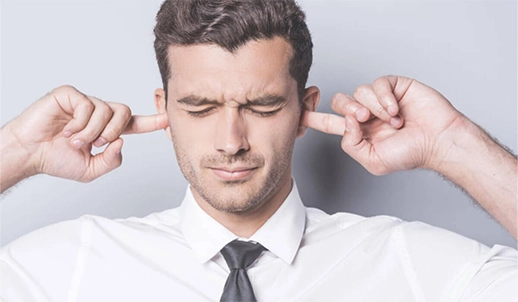
Is "noise" a synonym for loud, unwanted, and disturbing sounds? No, because noise has many facets and is a subjective experience.
At a Glance
- City, countryside, loud, quiet—everyone perceives noise differently
- How hearing suffers from chronic noise exposure
- What is noise-induced stress? It takes a toll on the entire body
What one person may consider a pleasant or at least tolerable background sound, another may already perceive as distressing noise. After all, volume isn’t everything. Noise levels are measured in decibels. But even quieter sounds, certain timbres, or very specific everyday noises can be perceived by some people as highly disruptive and cause noise-related stress.
How does the ear perceive noise?
How we perceive sounds and whether noise bothers us depends on many factors. These can include how we’re feeling that day, a shift from a familiar to an unfamiliar environment, our emotions, or the sensitivity of our hearing.
Prof. Dr. Janina Fels, professor of hearing technology and acoustics at the Janina Fels Institute at RWTH Aachen University, explains: “For example, sounds with the same decibel level may be perceived acoustically in completely different ways. One sound may be very disturbing to the ear, while another is not, even though they have the same decibel level.” This is because the perception of sound—and noise-induced stress—cannot be measured objectively but is rather a subjective impression.
Differences Between Urban and Rural Areas
“As a rule, a sound becomes noise when it is disruptive,” says Prof. Dr. Brigitte Schulte-Fortkamp. She is a professor of psychoacoustics, sound perception, and the effects of sound at the Institute for Technical Acoustics at TU Berlin. According to the scientist, for people who live in cities with a constant background noise level, these sounds can be very different from those experienced by people in rural areas, who are primarily surrounded by natural sounds or the ringing of bells.
When Hearing Is Damaged
Constant noise and persistent sounds can lead to health problems. For one thing, direct damage to hearing can occur when you’re frequently exposed to high noise levels. This actually comes down to decibel levels—in other words, loud noises.
At levels of 85 decibels or higher, permanent hearing damage can occur quickly. That’s why hearing protection is mandatory for workers at or above this level. This is because noise destroys the hair cells in our ears, which are responsible for our ability to perceive sound. These cells do not regrow. For this reason, noise-induced hearing loss is irreversible.
But even quieter sounds can be very stressful for people—especially when a disturbing noise keeps recurring. Specialists refer to this as psychological impairment caused by individual sensitivity to noise and as noise-induced stress.
Does noise cause not only hearing damage but also noise-induced stress?
Noise can indeed cause stress—because it’s usually impossible to actively turn off noise or easily escape it. If someone feels constantly disturbed by noise, it has consequences.
- Tinnitus: Our hearing reacts to frequent noise-related stress—often with tinnitus.
Other noise-related problems include:
- Difficulty concentrating
- Sleep disturbances
- Cardiovascular diseases
- High blood pressure
- Inner restlessness
- Anxiety
- Irritability
In some cases, people may also develop a tolerance—that is, a reduced sensitivity to certain noise sources. According to Prof. Schulte-Fortkamp, those affected are particularly vulnerable in such situations. Because they no longer perceive the noise as disturbing, they do not adequately protect themselves from loud sounds and other environmental factors.
You Might Also Be Interested In

Wenn Spielzeug zu laut ist
Ohren auf beim Kauf der Weihnachtsgeschenke für die lieben Kleinen: Denn oftmals ist Spielzeug zu laut und schädigt das Gehör – und das gilt ganz besonders für die empfindlichen Baby- und Kinderohren.
How We Can Protect Our Hearing
We should take good care of ourselves, prevent hearing damage, and protect our hearing. After all, our ears are unique sensory organs. The best approach is to reduce noise exposure as much as possible. In many cases, hearing protection such as earplugs or noise-canceling headphones can help. Foam or wax earplugs are available from hearing care professionals.
Consult the experts in hearing health to find the right hearing protection for your professional or personal needs—or for your children. Depending on the shape of your ears, there is custom-fit hearing protection available, including options for many sports. In addition, hearing protection can be checked regularly at hearing aid specialist stores to ensure it remains secure and fits properly.
If you feel that you are suffering from noise-induced stress or have already noticed changes in your hearing, having a hearing test done by a hearing care professional or seeing an ear, nose, and throat doctor is an important step. We only have one set of ears—that’s why we should take action early.