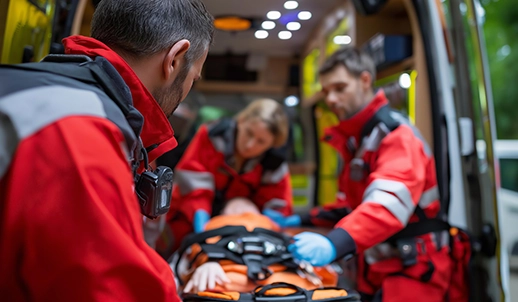
An emergency call comes in—every second counts! Julia Fraschka is right in the thick of the Malteser rescue team in Winnenden-Hertmannsweiler, in the Rems-Murr district near Stuttgart. She is Germany’s first deaf emergency medical technician. Two cochlear implants have enabled her to pursue her dream career and live an independent life. Through her story, this young woman hopes to encourage others with disabilities and demonstrate how inclusion can work.
From Hearing Loss to a Dream Job in Emergency Medical Services
Julia Fraschka was born with hearing loss due to a genetic defect. She has worn hearing aids since she was a toddler. During puberty, her hearing continued to deteriorate until she lost her hearing completely. As a teenager, she finally decided to get cochlear implants in both ears.

Unlike hearing aids, which amplify sound, cochlear implants bypass the damaged, non-functioning part of the inner ear—allowing people with sensorineural hearing loss to hear again.

Julia Fraschka never let her hearing impairment hold her back. Even while taking her high school graduation exams, she was already making career plans. It became clear early on that she didn’t want to take an office job, but rather work directly with and for people. At first, she planned to become a special education teacher. But during an internship in an emergency room, she discovered her dream job—working in emergency medical services.
In her hometown of Winnenden, the Paulinenpflege Vocational High School offers paramedic training even for students with hearing impairments. She enjoyed the training so much that, after passing her high school graduation exams, she decided to make emergency medical services her career. She applied for a training position with the Malteser and, as the first deaf emergency medical technician in Germany, has been part of the team since August 2019. Julia Fraschka has been working full-time since 2022.
Read more: https://www.swr.de/swraktuell/baden-wuerttemberg/stuttgart/deaf-paramedic-malteser-winnenden-100.html?mediaId=fe00df89-9bee-38b9-b0f1-0319d8b4a80b& (Source: SWR)
New Perspectives Through Inclusion
Inclusion means that people with hearing loss can participate in social and professional life as a matter of course and without barriers. Prejudices are often unfounded: Like Julia Fraschka, people with hearing loss often possess unique strengths that benefit their professional roles. In Julia Fraschka’s case, for example, this includes a strong willingness to help others and a deep motivation to assist people. Due to her hearing loss, she herself has often needed support, which she did not always receive. Through her work in emergency medical services, she now wants to ensure that others receive the help they need.
Between Technology, Bureaucracy, and Prejudice
To become Germany’s first deaf emergency medical technician, Julia Fraschka had to overcome several hurdles. These included numerous discussions with the company doctor and insurance companies. “I rely on my cochlear implants, which means that if something malfunctions or a battery suddenly runs out, I always have to make sure I have a replacement,” says Julia Fraschka in an interview with Malteser. “Otherwise, I’m completely deaf and can’t work. New technology and devices aren’t easy to come by, and health insurance companies don’t cover everything without question.”
One of the biggest challenges was her special stethoscope, which connects to her cochlear implants. Because of her hearing loss, she cannot use a normal stethoscope. “To get the stethoscope paid for, I had to run from office to office for nine months, filling out lots of forms and questionnaires, until it was finally clarified who would cover the costs,” says Julia Fraschka. But in the end, it all worked out.
The search for a company to provide her apprenticeship was also difficult at first. Yet her hearing loss isn’t noticeable while she’s working and doesn’t limit Julia Fraschka in any way. “A lot of places turned me down without even giving me a chance to say ‘hello’ and show that I can actually communicate with them normally,” she says. She finally got that chance at the Malteser organization in Winnenden.
Hearing Health and Hearing Care as the Key to Active Participation
Good hearing often determines how actively a person can participate in life. A healthy sense of hearing
- facilitates communication, collaboration, and quick reactions.
- It supports independence, social interactions, and mental well-being.
- People with hearing loss tend to withdraw more often—which affects their quality of life and health.
Modern hearing aids and cochlear implants can play a significant role in restoring quality of life by helping those affected to actively participate in life and work again. Julia Fraschka’s story shows that when work environments and communication are adapted accordingly, everyone benefits. At the same time, inclusion strengthens social participation, self-confidence, and, in the long term, mental health—a key factor in quality of life.
Cochlear implants restore quality of life
Cochlear implants not only enable better speech comprehension, greater confidence in everyday life, and increased social participation, but they also support cognitive performance. Improved hearing reduces the strain on the brain and can have a positive effect on concentration and mental fitness.
Furthermore, modern systems can be customized to individual needs and listening situations. They can also connect to smartphones, streaming devices, or assistive technology, thereby expanding their use in daily life beyond just hearing. Julia Fraschka’s cochlear implants also allow her to connect to a stethoscope and hear patients’ heartbeats directly through the CI.
Alongside ENT doctors, hearing care professionals are the most important points of contact for cochlear implant users. With their expert guidance, they often support patients over a long period of time and help them find the best possible hearing solution. They conduct hearing tests, assist with the selection and fitting of hearing aids, handle fine-tuning for various everyday situations, and, with additional training, can even offer audiotherapy to help patients learn how to use their cochlear implants.
Use our hearing aid specialist locator for all of Germany to find a specialist near you: https://www.ihr-hoergeraet.de/akustiker-suche/.
Greater Inclusion in the Workplace with the Right Support
Examples like Julia Fraschka show that, with the right conditions and modern hearing technologies, many doors are open to people with hearing loss. Her inspiring story was even featured in 2025 as part of the ZDF documentary series “Hearing Aids: A New Life for the Deaf?” on the “einfach Mensch” program.
The earlier hearing loss is diagnosed, the better the chances of addressing it with modern hearing technology. Use the hearing care professional finder to locate a hearing care professional near you and schedule a hearing test. Or start right away with our online hearing test to get an initial assessment.
See how good hearing works

Tips & Tricks for Living with Hearing Loss — Episode 1: Talking Openly About Hearing Loss

Tips & Tricks for People with Hearing Loss — Episode 2: All the Things a T-Coil Can Do

Teaser Video Series: Tips & Tricks for People with Hearing Loss

Tips & Tricks for People with Hearing Loss — Episode 3: Improving Room Acoustics

Tips & Tricks for People with Hearing Loss — Episode 4: Saying What You Need