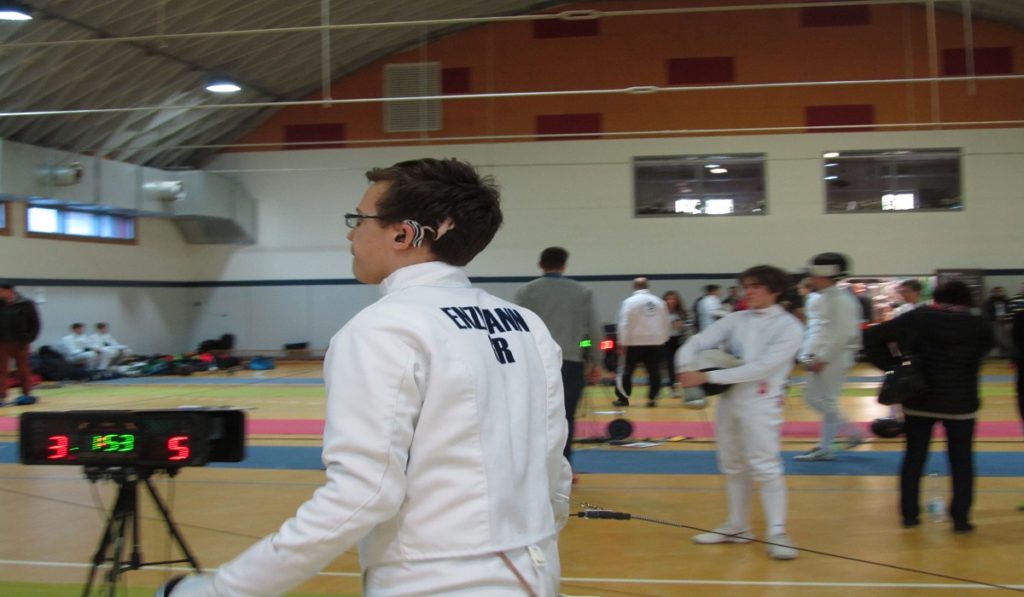
The two-time German fencing champion talks about his sport
Despite his hearing impairment and thanks to a cochlear implant, Jonas Enzmann from Leipzig can already look back on an impressive athletic career at just 17 years old.
Coaches’ instructions, opponents’ movements outside one’s field of vision, shouts from teammates, or the referee’s commands—a functioning sense of hearing is often crucial to success in sports. This is also true for épée fencer Jonas Enzmann from Leipzig. The 17-year-old has been nearly deaf since birth. His parents first noticed their son’s hearing loss during a visit to church. An unusually loud organ startled the congregation, but it had no effect whatsoever on Jonas, who was nearly 1 year old at the time. Following subsequent examinations, he received his first Nucleus cochlear implant (CI) at 12 months of age—the second followed when he was 6 years old.
Achieving Athletic Success with a Cochlear Implant
Jonas is now a 12th-grade student at a sports high school in Leipzig and achieved success in fencing at an early age. He has been the Central German champion and Saxon state champion in foil and épée fencing on multiple occasions. His greatest achievements were winning the German A-Youth Championship in team épée fencing in 2016 and defending the team title in 2017.
Jonas is convinced that he couldn’t practice his sport without his cochlear implants: “I have to hear when the blades of the weapons touch to know that I’ve parried. I also have to hear my opponent’s footsteps and the commands of the referee. All of this is only possible with the CI. Without my hearing implants, I wouldn’t be able to fence successfully.” Incidentally, Jonas doesn’t feel limited by the implants: “The hearing aids don’t have a major impact on my fencing. I hear perfectly normally with them.”
Early Intervention Is Crucial
Other people with hearing loss report distorted or tinny sound transmission through the CI. It’s no coincidence that Jonas gets along so well with the implants. Various studies show that the duration of hearing loss has a major impact on how well patients with a CI can hear. Because the procedure was performed immediately after birth, Jonas was able to adapt to it optimally.
Good results are also achieved with CI in adulthood, provided the hearing loss did not occur too long ago. “It is therefore important for those affected to take immediate action when a hearing aid no longer provides sufficient benefit,” confirms Patrick D’Haese, a cochlear implant expert at MED-EL Medical Electronics, whom we interviewed for this article about when the use of a CI is advisable.
Incidentally, during his student internship at an audiologist’s office in Leipzig, Jonas developed a desire to help other people with hearing loss. Since then—just under two years ago—he has wanted to pursue a career as a hearing aid specialist.
How does a cochlear implant (CI) actually work? The CI is implanted in the cochlea and takes over the function of the damaged parts of the inner ear—the cochlea. A new hearing test can also predict speech understanding with an implant.