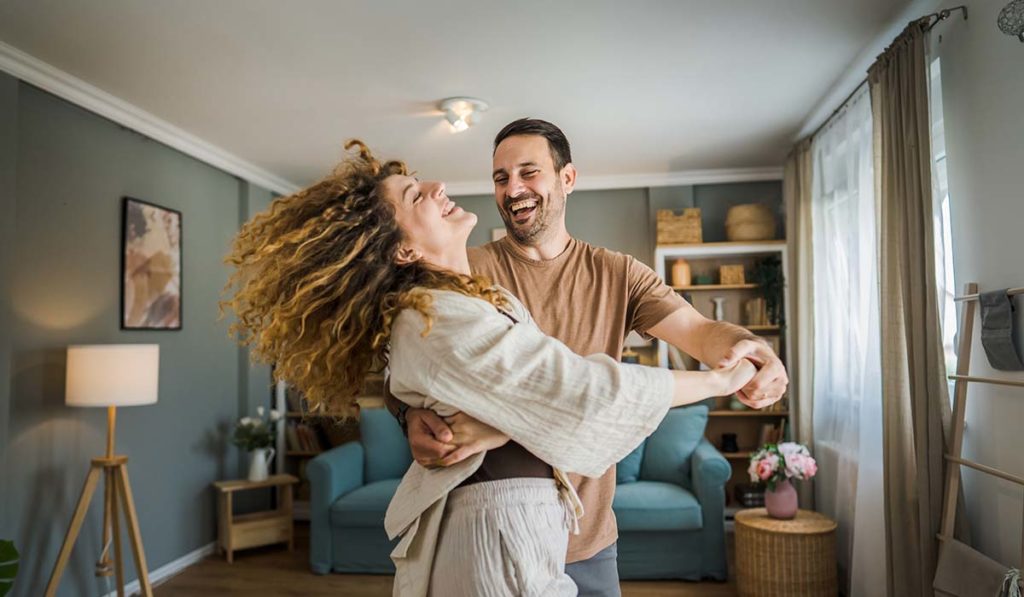
For many people, music and dancing are an important part of enjoying life and feeling good. Untreated or undetected hearing loss significantly limits this experience. Yet it is precisely people with hearing loss who can relax well through athletic or creative hobbies and give their ears and brains a break. Hobbies like dancing are also great for maintaining social connections and playfully training one’s sense of balance.
How Hearing Aids Enhance the Dancing Experience
Modern hearing technology helps people with hearing loss experience their hobbies with all their senses. It also makes dancing with hearing aids a particularly intense experience.
- Hearing aids improve the perception of sounds and ambient noise.
- Modern hearing aids can be specifically adjusted for music and dance environments using an app or a program button—for example, through a music profile or targeted amplification of low frequencies, which are particularly important when dancing.
- With hearing aids or cochlear implants, music can be heard clearly and in high quality, which can foster a creative mood and motivation.
- Hearing aids improve communication with other dancers.
- Modern hearing aids are equipped with Bluetooth and can connect directly to audio sources. This allows music to be streamed directly into the dancer’s ear.
Powerful sound, secure fit
There are now even special hearing aids and software designed specifically for music lovers and dancers. Contact your local hearing care professional to discover a whole new way to enjoy dancing with hearing aids.
When dancing with hearing aids, they usually stay in place so securely that dancers don't lose them. If they do happen to slip due to rapid head movements or sweat, many dancers turn to special fasteners such as sports clips or sweatbands.
We don't just listen to music—we feel it
Music is an important source of inspiration, and dancing while wearing hearing aids is a particularly intense experience. Hearing loss is therefore no obstacle to pursuing a hobby—or even a career—involving music and dance.
The same applies, by the way, to deafness, because we perceive music with our entire body. First and foremost, we hear music with our ears. However, we also feel the sound waves—and especially the bass—through our diaphragm and skin. That’s why even people with untreated hearing loss, including those who are deaf, can feel the rhythm of music and dance to it.
Actor and martial arts master Benjamin Piwko also proved this in 2019: On the RTL live show “Let’s Dance,” he became the first deaf contestant to captivate an audience of millions alongside professional dancer Isabel Edvardsson and made it all the way to the dance show’s finals. The Nikita Dance Crew also demonstrates that dancing with hearing aids or while being deaf is no problem at all: They don’t dance to loud music by any means, but simply turn up the bass a bit so they can feel it more clearly in their bodies. In the dance studio, the subwoofer is also placed directly on the wooden floor, so the dancers can feel the vibrations through their feet as well.

Let's go to the movies!
From the dance floor to the movie theater: Many movie theaters today are equipped to meet the needs of people who wear hearing aids and offer special technical solutions to enhance the movie-watching experience.
- Some hearing aids feature a T-coil, which allows appropriately equipped movie theaters to transmit the movie’s audio directly to hearing aids via an inductive loop system.
- Apps designed specifically for the movie theater experience also provide support for people with hearing loss, such as theGRETA app. The app makes audio descriptions, captions, and sound amplification accessible in any movie theater, in any auditorium, for any showtime—all from your own smartphone.
- The latest Bluetooth technology is Auracast™. In stereo quality, an unlimited number of receivers can receive the audio on compatible smart devices. In venues where public address systems are used—such as airports, movie theaters, auditoriums, conference centers, places of worship, etc., visitors can receive the audio directly through their own Bluetooth® headphones via Auracast™ broadcast audio or hearing aids, thereby experiencing significantly higher audio quality.
- Movie theaters also use the Roger system, such as the Fimbühne in Bad Nauheim. Thanks to Roger receivers installed in the theater auditorium, the movie’s audio is transmitted wirelessly and without interference to hearing aid or cochlear implant users.
Incidentally, the best seats are located in the middle of the rear third of the theater. That’s where the sound quality is usually the most balanced. Good preparation is also important: Hearing aid users should inquire in advance about accessibility options at the theater of their choice, as equipment and services vary.
So dancing with hearing aids isn’t just possible—it can be a lot of fun. Many hearing aid users benefit from a more conscious connection to music, rhythm, and movement. Untreated hearing loss, on the other hand, can not only diminish one’s passion for dancing and music but also reduce quality of life. This makes it all the more important to treat hearing loss early and with modern hearing technology. You can learn more about this in our article “Better Quality of Life Thanks to Hearing Aids.”



