Succeeding in College Despite Hearing Loss
People with hearing loss have to manage a lot during their studies and need some support to succeed.
At a Glance
- Successful studies thanks to sign language interpreters and support from fellow students.
- Assistive technologies that make everyday life easier for students with hearing loss.
- Gallaudet University: The only university in the world where students can study in sign language.
For children and adolescents with hearing loss, there are preschools and schools that are fully tailored to people who are deaf or hard of hearing. Not only do they learn sign language there, but specially trained educators also ensure that each child can develop at their own pace and receives the appropriate support.
However, the situation is different when it comes to higher education. This is because there are no universities or universities of applied sciences in Germany specifically for people with hearing loss. That said, students with hearing loss in Germany receive support from sign language interpreters, and there are also several assistive technologies available to help them with their studies.
How can people with hearing loss go to college?
“When I’m at the university, I often feel like an outsider,” says Olga Hertle, who suffers from “hearing loss bordering on deafness.” She is studying early childhood education and family education at Cologne University of Applied Sciences. There, as a student with hearing loss, she has to navigate the world of the hearing. And that isn’t always easy. Many of her fellow students have no experience with people who have hearing loss and are therefore hesitant to interact with her, she explains.
When Olga Hertle arrives at the university in the morning, she meets with her sign language interpreters, who assist her during lectures. While the interpreters take their seats next to the lecturers’ podiums, the student with hearing loss sits in the front row of the lecture hall. The interpreters translate everything that is said, yet it is extremely difficult for Hertle to simultaneously follow the interpreters’ signs, read the slides on the wall, and take notes. “I need my eyes to listen, read, and take notes,” she explains. That’s why Olga also receives additional support from a fellow student who acts as her “note-taker” and copies her notes for her at the end of each lecture.
Before this student with hearing loss had access to these support services, she had to do a lot of organizing. For about five months, she filled out applications, obtained certificates, and even had to arrange for interpreters and a “note-taker” on her own. The good news: The costs for the interpreters are covered by what’s known as “integration assistance.” Thanks to this support, the student with hearing loss is doing well; she has passed all her exams so far with very good grades.
Information on Sign Language and Written Interpreters
- German Association of the Deaf (Deutscher Gehörlosenbund e.V.) – Placement Center for Sign Language Interpreters
- Federal Association of Sign Language Interpreters of Germany e.V. – Addresses of state associations and independent members
- German Association of the Hard of Hearing (Deutscher Schwerhörigenbund e.V.) – Written interpreters
- Federal Association of Written Interpreters
- Institute for German Sign Language and Deaf Communication at the University of Hamburg
You Might Also Be Interested In

Die Schulzeit mit Hörgerät
In der Fortsetzung der Beitragsreihe „Mein Leben mit Hörgerät“ erzählt uns die 22-jährige Cindy, wie sie ihre Schulzeit aufgefasst hat. Sie beschreibt uns, ihre persönliche Sichtweise auf ihren ersten Schultag und wie es für ihre Eltern war.
Schaufensterpuppe lernt Gebärdensprache
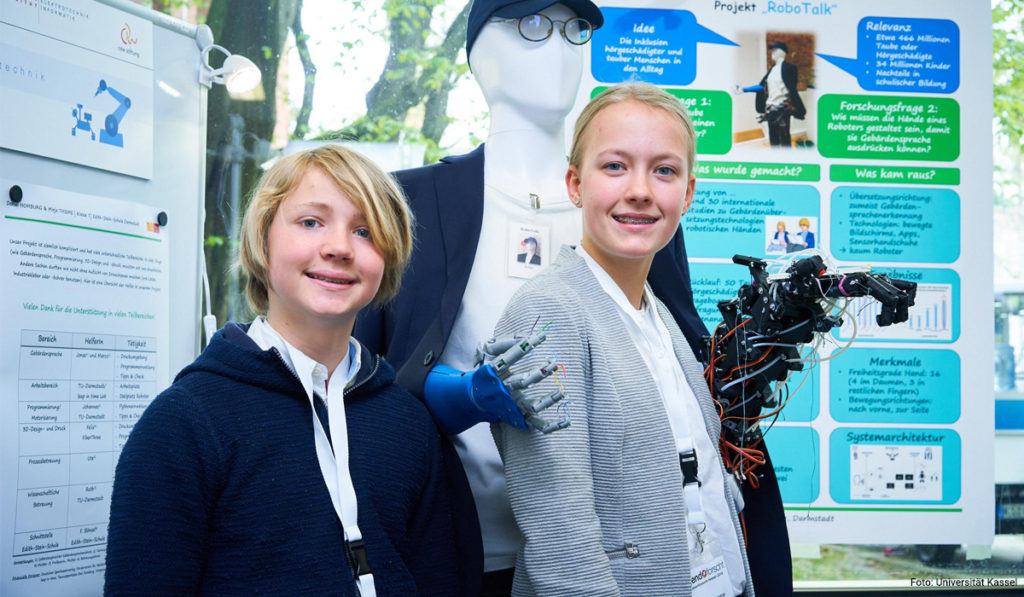
Zwei Schüler haben im Rahmen von „Schüler experimentieren Hessen 2019“ einen Roboter entwickelt, der gesprochene Sprache in Gebärdensprache umwandeln kann. Der BVHI (Bundesverband der Hörgeräte-Industrie) hat diesen Projekt unterstützt.
Eingelesen statt reingehört
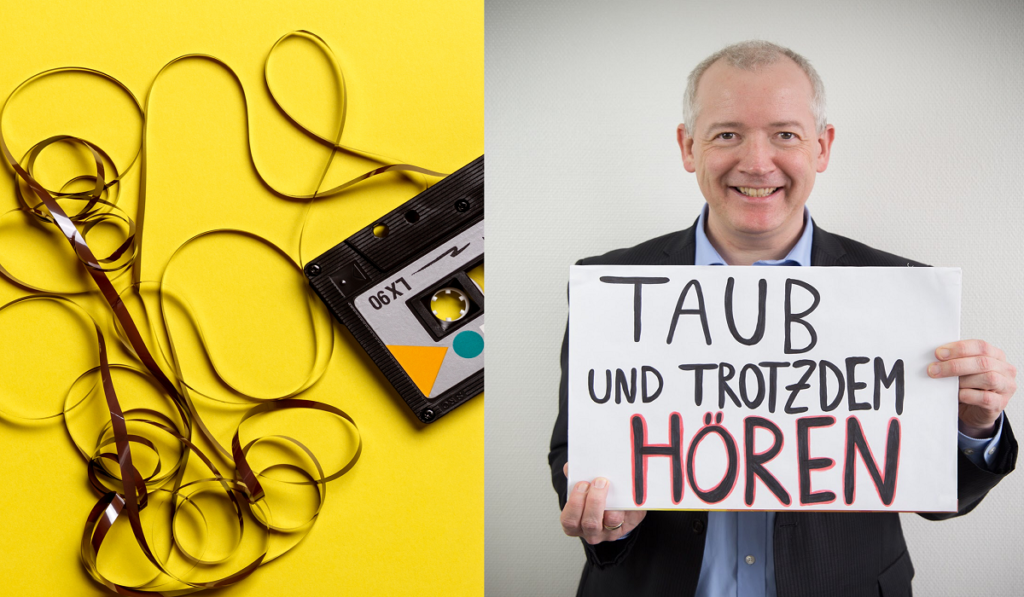
Michael Schwaninger musste früh auf sein Gehör verzichten. Wir haben mit ihm über seinen Lebensweg gesprochen – vom beginnenden Hörverlust bis zur akustischen Wiedergeburt.
What kind of individualized support is available for people with hearing loss?
Jana Kapralow is studying business administration at SRH University of Applied Sciencesin Heidelberg, where she benefits from personalized support for people with hearing loss. She receives assistance from sign language interpreters both during her studies and in her personal life. These interpreters are provided through a partnership between the university and SRH Vocational Rehabilitation.
“I get up in the morning and go to the university. A sign language interpreter is already sitting in my lecture or seminar, waiting for me. They stay with me all day long until the evening. That way, I can be sure that no important information is lost,” reports the business administration student. “Thanks to the lecture notes provided by the professors, I can also review the course material again.”
Thanks to the support of sign language interpreters, she is able to actively participate in her studies despite her hearing impairment. Like many other students, this student with a hearing impairment lives on campus. “The distances are shorter, and thanks to assistive devices in my apartment—such as a light signal system—I can be sure not to miss important appointments. I can also borrow a light alarm clock if needed,” adds the business administration student with hearing loss.
Fully Integrated into Campus Life
Jana Kapralow is very active in sports and otherwise participates enthusiastically in student life. “I have a lot of contact with other students. I’ve made friends with both hearing and deaf people. The interaction between deaf and hearing people through our studies and campus life is handled perfectly,” she explains.
“The sign language interpreter is also available to me for this. There’s also a doctor on campus who communicates well with deaf people. For communication with the administrative office, there are case managers. They serve as the link between me as a student and the funding agency—in my case, for example, the employment office.”
What assistive technologies are available to students?
In addition to human support, there are also a number of technical devices that help people with hearing loss navigate their studies more effectively:
- Wireless Microphone (FM) Transmission System (Microport Systems)
A wireless microphone transmission system transmits speech via a dedicated transmission frequency. Lecturers and fellow students are equipped with transmitters, while students with hearing loss have receivers. When used in conjunction with a hearing aid or cochlear implant, this system can largely filter out distracting background noise. FM systems and other wireless transmission systems are included in the assistive devices catalog of statutory health insurance providers and may be reimbursed by the respective health insurance companies.
In addition to the existing FM system technology, several hearing aid providers already offer more modern digital transmission systems. With these systems, there is no longer any need to adjust channels or frequencies. Some are Bluetooth-based, while others use wireless digital transmission operating in the 2.4 GHz band.
- Directional Microphones
Conference directional microphones enable targeted sound recording. The maximum range depends on the system and transmission technology used and can be up to five meters. Sound is transmitted directly to the hearing aid.
- Infrared systems
A few universities have infrared systems in their lecture halls and event rooms. In addition to a stationary transmitter, a receiver is required to transmit the signals to the hearing aid or cochlear implant via induction plates or an induction loop.
- Induction Loop Systems
Induction systems, such as those commonly used in churches or meeting halls, are rarely used in universities.
- Stethoscopes for Medical Students
For medical students with hearing loss, there are special stethoscopes with amplifiers that can either be used like other stethoscopes via an ear hook or connected directly to a hearing aid.
University for People with Hearing Impairments
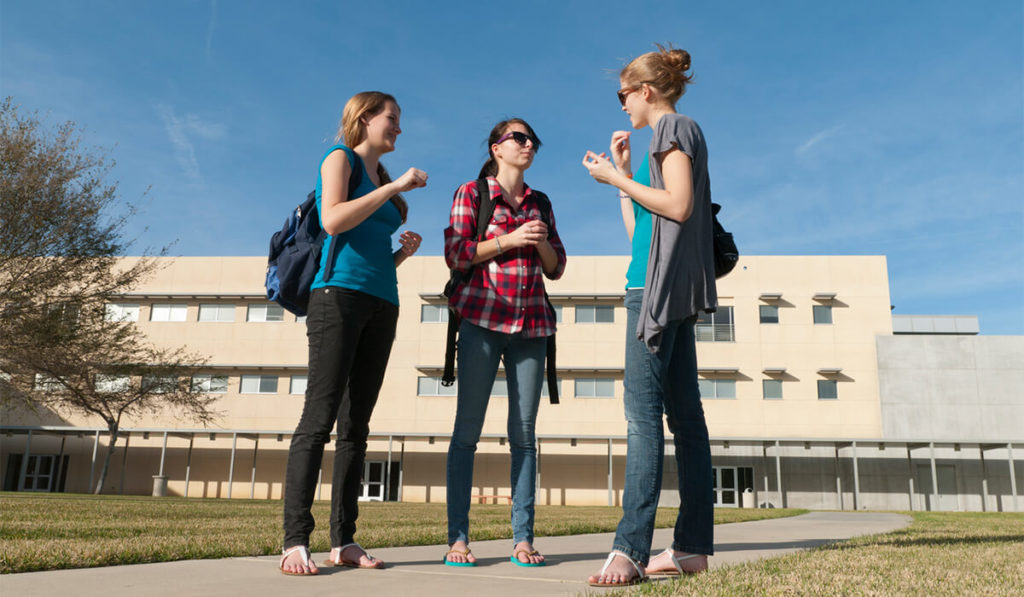
The only institution in the world where students can study in sign language is Gallaudet University in Washington, D.C. It is also the world’s oldest comprehensive university for people with hearing impairments. Even though the atmosphere on campus is often rather quiet, there is a lively exchange among the students. Fellow students laugh and gesture, flirt and debate—just like at other universities and colleges. However, they communicate in sign language.
To help students communicate with people who do not know sign language, simultaneous interpreters from the university’s own interpreting team are available. A total of about 1,800 students are enrolled at the university, about six percent of whom come from abroad. All students benefit from the many modern technical aids used to teach the course material.
Hearing and deaf children process information differently. You can read here about how children with hearing loss learn.