You’re sitting in a café; cups clink, and people are chatting animatedly at every table. Suddenly, you realize that more and more often, you can’t quite follow what the person you’re talking to is saying. In moments like these, many people ask themselves: Is it because of the noisy surroundings, or is my hearing getting worse? Only a professional hearing test can provide the answer to this question.
A professional hearing test, known as audiometry, is the primary method for medically assessing hearing ability and is used to detect hearing changes early on and to determine their type and severity. In this article, you’ll learn what happens during a hearing test, what the lines on your audiogram mean, and why regular professional hearing tests are so important.
What happens during a hearing test?
For a professional hearing test, it’s off to the testing booth! But what exactly happens during a hearing test? First, the good news: Audiometry doesn’t hurt, takes only a few minutes, and is free. A hearing test isn’t just about whether someone can hear well, but also how finely their hearing works and whether both ears hear equally well.
The hearing test is always preceded by a brief preliminary consultation and an examination of the ears. This is followed by several standardized tests that gradually assess different aspects of hearing ability. These tests build on one another and make it possible to evaluate both overall hearing performance and the interaction between the two ears, as well as any differences between them. The most common tests are:
- Hearing Threshold Test (Tone Audiometry)
- Speech audiometry
- Bone-conduction test
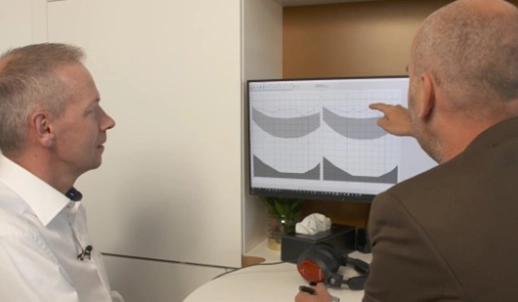
The results of all these measurements are presented in what is known as an audiogram, a graphical representation of your individual hearing profile.
The Hearing Threshold Test
During pure-tone audiometry, the hearing care professional measures the range of sounds you can hear. To do this, you’ll listen—usually in a soundproof booth—to tones of varying pitches (frequencies) and volumes (decibels). The tones start out very soft and gradually get louder. You press a button to indicate when you hear a tone. The test shows how sensitive your hearing is and up to which frequency ranges your hearing functions.
Speech Audiometry
Speech audiometry involves correctly understanding words or numbers, often in the presence of background noise. In some cases, bone conduction is also measured to determine whether the hearing problem lies in the inner or middle ear. To do this, test subjects wear special test headphones that allow the inner ears’ perception of sound to be tested and measured.
Online hearing test or professional hearing test—what's the difference?
Online hearing tests or quick hearing tests, such as those offered by ihr-hoergeraet.de, provide an initial indication of whether you may have hearing loss. They are simple, quick to complete, and well-suited for screening. While an online test can be a useful first step, it is no substitute for a professional diagnosis through a hearing test conducted by a hearing care professional or an ENT doctor.
After all, professional audiometry involves much more than that:
- standardized testing conditions
- precise evaluation
- personalized consultation with a hearing care professional
- The basis for a potential hearing aid fitting
Why Audiometry Is So Important
Regular hearing tests aren't just important for older adults. Gradual hearing loss can begin as early as middle age and go unnoticed for a long time.
If the first signs of hearing loss are detected early, it makes treatment much easier and can help prevent related problems, such as:
- social withdrawal
- difficulty concentrating
- increased listening effort
- impaired sense of balance and increased risk of falling
- disorientation
- reduced quality of life
Professional hearing tests are particularly beneficial for people aged 50 and older. This is because hearing gradually declines starting at this age, and age-related hearing loss (presbycusis) begins to set in. This is caused by wear and tear on the hair cells in the inner ear and damage from noise. The auditory nerve and the auditory center can also be affected by the aging process.
What is an audiogram?
An audiogram is a graphical representation of a hearing test and shows how well a person can perceive sounds and spoken language across different frequencies (Hz) and sound levels in decibels (dB). It serves as a key tool for objectively assessing hearing ability and identifying potential hearing impairments—such as hearing loss.
In audiological diagnostics, a distinction is generally made between two types of testing: tone audiometry and speech audiometry. The results of both tests can be clearly presented in an audiogram.
The Typical Hearing Curve for Age-Related Hearing Loss
To be able to identify deviations, you need to know what a normal hearing curve looks like: In a healthy ear, the hearing curve does not follow a curved line but rather a straight line.
However, an audiogram not only indicates the degree of hearing loss but also provides insights into the cause of the hearing impairment. A typical feature of age-related hearing loss is so-called high-frequency hearing loss in the range above 2,000 Hz: High-pitched and sibilant sounds such as “s,” “f,” or “sch” are perceived less clearly, which makes it harder to understand speech. The audiogram shows a curve that drops significantly in the high-frequency range—that is, on the right side of the horizontal frequency scale. Depending on age and the degree of hearing loss, this curve can be steeper or flatter.
Ask your hearing care professional!
The exact interpretation of an audiogram is always individualized and is therefore provided directly by your hearing care professional as standard practice after every professional hearing test. If you have any additional questions about your hearing or your audiogram:
- talk to your hearing care professional specifically about them
- ask them to explain the results in a way you can understand
- get regular hearing tests, even if you don’t have any immediate symptoms
This is because hearing is a sense that often deteriorates gradually and cannot be restored. Regular checkups provide clarity and enable timely treatment.
If the audiogram indicates hearing loss
Your audiogram is an important tool for hearing care professionals and ENT doctors. They can use it to determine whether you have hearing loss. This applies when your hearing loss exceeds 30 dB. In that case, you are eligible for a hearing aid.
Hearing care professionals need the audiogram not only for billing the public health insurance provider but also for properly customizing your hearing aids. These modern, high-tech devices automatically adapt to different listening situations, filter out background noise, and provide targeted support exactly where your hearing needs it. The result: better speech understanding, less listening effort, and greater confidence in everyday life.
From Hearing Tests to Hearing Aids
Hearing care professionals guide you from the initial hearing test all the way to finding the best hearing solution. At your next appointment, ask for a detailed explanation of your personal audiogram. When you understand your own hearing profile, you can make much more informed decisions about your hearing care.
You can find ENT practices and hearing aid centers throughout Germany using the hearing aid specialist search or ENT doctor search on ihr-hoergeraet.de.
Take Action: Your Path to Better Hearing
Audiometry is the key to good hearing. Whether it’s a self-test or a professional hearing test, the most important step is to take an active approach to your hearing health.
- Take an online hearing test now
- Use our quick hearing test as a starting point
- Learn more about hearing health in our Hearing Guide
- And when you have the chance, feel free to stop by a hearing care professional near you for a professional hearing test.