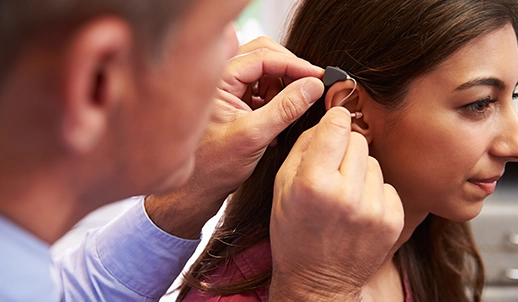
A diagnosis of hearing loss often raises a question for many people affected: What should I do now? The path back to better hearing can often seem confusing—from the steps involved in hearing aid fitting to the wide range of technical options, all the way to choosing hearing aids that truly fit. However, those affected don’t have to navigate this journey alone: hearing care professionals guide them through the maze of uncertainties, from the initial test all the way to a sound that feels right and natural in everyday life.
The First Step Toward Finding the Right Hearing Aids
Today, modern hearing aids offer solutions for a wide range of lifestyles and needs. The key is to find the right system, have the hearing aids fitted, and—above all—get the right advice. After all, good hearing doesn’t come from an off-the-shelf device, but from a personalized fitting tailored to your individual needs.
Making an appointment at a specialty store is a crucial step toward better hearing. Of course, you can also start gathering information on your own beforehand—for example, by researching online or talking to friends, family, and perhaps even people who have already gone through the hearing aid fitting process.
A visit to the hearing care professional opens up new possibilities
An appointment with a hearing care professional often feels like a real turning point. During a one-on-one consultation, you’ll receive answers to your questions, a thorough assessment of your situation, help in selecting and fitting a personalized hearing solution, and the guidance you need to confidently take the next steps. Uncertainty gives way to clarity, and together you’ll discover new perspectives. It’s not uncommon to find yourself thinking afterward: Why did I wait so long?
Untreated hearing loss has consequences
It is quite common for people to be reluctant to visit a hearing care professional or an ENT specialist when the first symptoms of hearing loss appear: According to EuroTrak 2025, nearly 11 percent of German citizens consider their hearing to be impaired. That corresponds to approximately 9.1 million people. Eighteen percent of them do not have their hearing loss evaluated by an ENT specialist and thus forgo a diagnosis and treatment.
This can have serious consequences: In addition to psychosocial effects, such as social isolation, declining self-esteem, or feelings of shame, the constant effort to perceive one’s surroundings despite limited hearing can also lead to physical strain. These include increased fatigue, exhaustion, headaches, cognitive decline, or stress.
The study shows that hearing aid use not only immediately improves hearing but also enhances overall quality of life: 97 percent of respondents confirm that their quality of life has improved as a result of their hearing aid use.
Finding your favorite sound takes time
Hearing aid fitting is technically and personally demanding. One of the biggest challenges is that hearing is a subjective experience. Two people with identical audiograms can therefore have completely different sound preferences—and the hearing care professional hears things quite differently still. That is why hearing aid fitting is a process that requires multiple appointments as well as close and trusting collaboration.
Other challenges include:
- Getting used to new soundscapes: Sounds that haven’t been heard in a long time may seem unfamiliar or distracting at first.
- Balancing amplification and natural sound: Too much amplification can be unpleasant; too little is ineffective.
- Different listening situations: Everyday life, work, and leisure each place different demands on hearing aids.
- Communication between the hearing care professional and the hearing aid user: Precise feedback is crucial for the correct fitting of hearing aids, but it is not always easy to articulate.
Fitting Hearing Aids—Step by Step
- Medical History
During the needs assessment, the hearing care professional will ask you questions about your lifestyle, preferences, and listening habits. This allows them to tailor the hearing aids specifically to your daily activities and needs. Your personal goals regarding hearing—such as being able to understand your grandchildren better, listening to music, or talking on the phone at the office—also play an important role. This motivation provides the energy that helps you adjust to the new hearing technology. - Hearing
AssessmentThis is followed by a detailed analysis of your hearing ability. The hearing test is always preceded by a preliminary consultation and an examination of your ears. Afterward, various types of tests and examination procedures are performed. The most common are the hearing threshold test (tone audiometry), speech audiometry, and the bone conduction test. The hearing care professional then evaluates your individual audiogram. This provides insights into the type and extent of your hearing loss and thus serves as the basis for a customized hearing aid fitting. - Ear Impression
If necessary and desired, the hearing care professional will take an ear impression to create an exact model of your ear canal and outer ear. This is done either by taking a physical impression or using a digital scan. The result is an otoplastic—an ear mold—which serves as the foundation for custom-fitted hearing aids. The earmold serves as a precise connection between the hearing aid and the ear canal and ensures optimal fit. - Selecting the Right Hearing System
Based on the results of the audiogram, you’ll then work with your hearing care professional to select suitable hearing aids that are optimally tailored to your type of hearing loss, your comfort preferences, and typical usage scenarios. - Initial
Fitting
The hearing aid is programmed using audiological fitting formulas. The goal is to establish an initial, functional baseline setting based on the data collected during the medical history and hearing assessment. - Trial
PeriodMany locations offer their customers the opportunity to test the selected hearing aids over a specific period of time. This is because you’ll only realize, when wearing them in everyday situations, whether the features of your hearing aid meet your needs or whether the hearing care professional needs to make further adjustments. - Fine-Tuning and Optimization
After the trial period, your hearing care professional will optimize your hearing aids—often gradually over several appointments—so you can test each adjustment again. Your feedback from everyday life is incorporated into every adjustment. - Adjustment Period and Hearing Training
The brain first needs time to process the new auditory impressions. This can take some time, and hearing may feel unfamiliar during this period. Regular use and targeted hearing exercises support this process. Hearing training enhances speech comprehension, directional hearing, and the ability to distinguish between sounds by specifically training the brain to process auditory signals. Audiotherapy complements the technical solution with counseling, psychosocial support, and assistance in coping with hearing loss or tinnitus. - Long-Term Follow-Up
CareEven after the initial fitting, ongoing care remains important to address changes in hearing ability or new challenges.


How do in-the-ear hearing aids sound?
Every ear has different requirements when it comes to hearing aids. That’s why it’s not enough to adjust their sound based solely on a hearing test:
- Real-ear measurement checks how hearing aids sound directly in the wearer’s ear. To do this, a very thin measurement tube is placed in the ear canal while the hearing aid is being worn. This tube measures how loud certain sounds actually are when they reach the eardrum. This allows hearing care professionals to see exactly whether speech is easily understood and whether everything is set correctly.
- In-situ fitting works slightly differently: Here, the hearing aids themselves emit sounds. The wearer provides feedback on what they hear. This allows the hearing aids to be adjusted precisely to the individual’s hearing ability.
High-Tech for Your Ears
Modern digital hearing aids are small, discreet, and available in many colors and shapes. Their range of features has expanded tremendously in recent years. Many models are now capable of, among other things:
- Suppress reverberation, background noise, and wind noise, thereby improving speech intelligibility
- Suppress feedback, which was typically recognizable by a whistling sound in older models
- Detect and attenuate impulse noises, such as slamming doors
- Shift high-frequency sounds—such as children’s laughter—to a lower, more audible range
- use directional microphones to capture the speech of conversation partners clearly and intelligibly and isolate it from ambient noise
- Use wireless technologies like Bluetooth to connect to smartphones, TVs, or smart devices in the smart home and stream sound directly into the ear
Modern AI-powered hearing aids contain powerful chips that analyze acoustic environments in real time. They detect where speech is coming from, how loud background noise is, and how the soundscape is changing. Based on this analysis, they automatically adjust signal processing to emphasize speech and reduce background noise.
Your Partner on the Path to Better Hearing
Hearing care professionals are specialists in good hearing. They combine empathy and technical expertise with skilled craftsmanship. They are responsible for customizing, optimizing, and maintaining hearing aids. Just as important as the technology is their ability to interact with people: hearing aid specialists provide clear explanations, offer comprehensive advice, and guide their clients every step of the way. They often work closely with doctors or other professionals.
Use our search tool to find hearing care professionals throughout Germany, including those near you: https://www.ihr-hoergeraet.de/akustiker-suche/.
Ready for better hearing?
The path to better hearing begins with the first step: an appointment with a hearing care professional. With the right guidance, modern technology, and a little patience, you’ll gradually experience a hearing experience that noticeably improves your quality of life. In the video or article series “We Ask a Hearing Care Professional” from Ihr-Hörgerät.de, you can clearly follow the steps involved in a hearing aid fitting before your first appointment.
If you’d like to test your hearing at home first, you can try our quick hearing test.