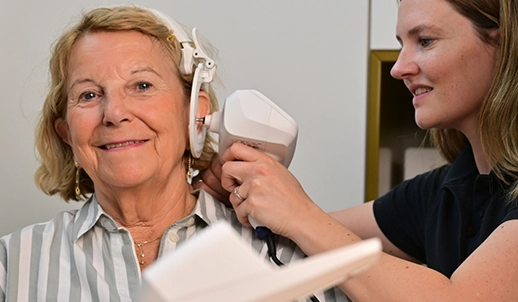
Conversations become exhausting, voices blur together in restaurants, and during a visit to an ENT doctor, it becomes clear that you need hearing aids. Under state health insurance, the process typically proceeds step by step: first through a doctor’s prescription, then to a hearing care professional, and finally to the health insurance provider. Hearing care professionals will advise you on all your questions and even handle the application and billing for you.
Hearing health begins long before hearing aids
Modern hearing aids come in many colors and different shapes. There are in-the-ear hearing aids and behind-the-ear hearing aids. A hearing care professional will advise you based on the type of hearing loss and the anatomy of your ears. Hearing aids are medical devices. Therefore, their provision is contingent upon a medical diagnosis by a specialist and follows established care pathways. This ensures a medical examination by an ENT doctor and a professional consultation and fitting by a hearing aid specialist. In addition, these defined procedures ensure that hearing loss, everyday situations, and medical necessity are considered together.
Quick Overview: Here's How the Hearing Aid Fitting Process Works
The process begins with a diagnosis from an ENT doctor. This is followed by model selection, a fitting, and a test to determine suitability for everyday use at the hearing care professional’s office. Only once it becomes clear which hearing aid is medically appropriate and suits your individual lifestyle will the process move on to the cost estimate, insurance claim, and billing with your health insurance provider. Your hearing care professional will handle this for you.
Take Early Action for Hearing Loss
People with hearing loss don’t just miss out on sound—they often lose quality of life as well. During conversations, they have to concentrate harder just to understand what’s being said. This takes a toll and often leads them to avoid conversations altogether. Especially during important appointments, while driving, on the phone, or with family, hearing loss can quickly lead to feelings of insecurity. Many people with hearing loss tend to withdraw because groups, restaurants, or family gatherings become too exhausting.
Early diagnosis and subsequent fitting with hearing aids are important because the ear hasn’t yet become “unaccustomed” to hearing over the years. After all, when sounds and speech are missing for a long time, the brain has a harder time processing them. As a result, adjusting to hearing aids later on is often more difficult than necessary. That’s why it’s important to know that the process of getting hearing aids doesn’t have to be an overwhelming experience.
Choosing Hearing Aids: The Most Common Questions
People who need hearing aids for the first time, in particular, often ask themselves the same organizational and financial questions:
- Will the hearing care professional handle the application with the public health insurance provider? Yes, hearing care professionals handle this process.
- Is a prescription from an ENT doctor required? Yes, a prescription from an ENT doctor is required to receive hearing aids.
- Follow-up care also raises questions: When will new hearing aids be available? Is a new ENT prescription needed for that? If medically necessary, statutory health insurance plans generally subsidize new hearing aids every six years.
Five Steps to Getting New Hearing Aids
Even if the path to good hearing seems complicated at first, it’s easy to tackle it step by step. That’s because the hearing aid fitting process usually follows a set procedure:
Step 1: Diagnosis and Prescription by an ENT Doctor
The first step is to see an ENT specialist. During the visit, the doctor will determine whether you have hearing loss and what is causing it. If hearing aids are medically necessary, the ENT specialist will issue a prescription. This prescription serves as the basis for coverage under the statutory health insurance plan.
Step 2: Choose a hearing care professional, get advice, and try out hearing aids
Take the prescription to your hearing care professional. That’s where the actual fitting process begins: a hearing test, a consultation, selecting suitable hearing aids, and trying them out in everyday situations.
Step 3: Cost Estimate, Application, and Approval
If you decide to get hearing aids after the trial period, the hearing care professional will prepare a cost estimate. He or she will typically submit the claim to your health insurance provider and handle the billing later.
Step 4: Adjustment, Completion, and Billing
After successful testing in everyday use and the necessary individual fine-tuning, hearing aids are permanently fitted for you. Under statutory health insurance, the hearing care professional bills the health insurance company directly for the agreed-upon services. For insured individuals, this “benefit-in-kind” principle means they generally do not have to pay upfront.

Document Checklist for Hearing Aid Fitting
The following documents are important when getting hearing aids:
- Medical prescription from the ENT doctor
- Insurance card
- Cost estimate from the hearing care professional
- If applicable, a statement of additional costs if higher-end devices are selected
- Invoices and documents for future reference
After Approval: What Does Health Insurance Cover?
People with public health insurance are entitled to high-quality hearing aids at no additional cost, provided they have a doctor’s prescription and the devices are medically appropriate. In such cases, the only cost is the standard copayment of about 10 euros per hearing aid. For those with private health insurance, reimbursement depends on their plan.
The Difference Between a Fixed Amount, Copay, and Additional Costs
The fixed amount is the upper limit up to which statutory health insurance covers the cost of care under its contracts. It currently amounts to up to approximately 741 euros for the first hearing aid. You are only required to pay a statutory copayment—known as the “statutory copay”—of ten euros per hearing aid. If you choose a model with additional features, there will be additional private costs that you must cover yourself. These are documented in a statement of additional costs.
What's included with hearing aids that don't require a copay?
With a coverage plan that requires no copayment, not only are the hearing aids themselves covered, but—depending on the contract—fitting, trial periods, follow-up care, and repair services are also included. For children and adolescents under the age of 18, health insurance plans often also cover the cost of batteries or rechargeable batteries.
For adults, the coverage period is generally six years. After this period expires, follow-up coverage may be available. In certain situations, the process may differ—for example, in the event of loss or early replacement. A new doctor’s prescription is not always required for a replacement after the six-year coverage period has expired. However, a prescription may be required again for an initial fitting, in the event of loss, or for a replacement within the six-year period.
Keep Your Receipts: Taxes, Warranty, and Aftercare
You shouldn’t just file away invoices and documents and forget about them. They may become important later on, for example, for warranty issues, repairs, future replacements, or tax matters. The United Income Tax Assistance Association (VLH) classifies hearing aids as medical devices in the strict sense. Costs not covered by health insurance may, under certain circumstances, be claimed as an extraordinary financial burden, provided that the reasonable out-of-pocket limit is exceeded.
Small but mighty!
Modern hearing aids are digital marvels. Even devices covered by insurance must meet certain minimum technical standards according to the specified sources, such as multi-channel capability, noise cancellation, feedback suppression, and multiple hearing programs. Those who opt for greater convenience can choose additional features such as Bluetooth, a rechargeable battery, or other control options. However, these extras are not automatically covered by health insurance.
Important Companions on the Path to Better Hearing
The hearing care professional advises you, helps you test different devices, fits your hearing aids, usually handles communication with your health insurance provider, and supports you throughout the entire service period. Hearing aid settings should be checked regularly, and the hearing aids should also be serviced and cleaned. This is especially important with your first hearing aids, as good hearing rarely is achieved in a single appointment. Fitting and getting used to the devices take time and require proper guidance from experts.
Practical Tips for Everyday Life
- After receiving your diagnosis from an ENT specialist, schedule an appointment with a hearing care professional right away so that the fitting process can begin promptly.
- Test hearing aids not only in a quiet room, but also while shopping, during family conversations, or out and about.
- Ask for an explanation of any additional costs if you want convenience features such as Bluetooth, a rechargeable battery, or a particularly compact design.
- Keep your prescription, cost estimate, explanation of additional costs, and invoices in a safe place.
- Take advantage of follow-up appointments, as fine-tuning is often part of the process of achieving good hearing.
In Germany, the provision of hearing aids is regulated by law and handled by ENT doctors, hearing care professionals, and health insurance companies. Anyone seeking assistance can contact an ENT practice or a hearing aid specialist near their home. You can find them using our hearing aid specialist search or ENT doctor search on Ihr-Hoergeraet.de.
The Path to a Hearing Aid: Often Easier Than You Think
Getting hearing aids isn't complicated. The key is to understand the process: first, get a prescription from an ENT doctor; then, select and try out hearing aids with a hearing care professional; and finally, submit a claim and settle the bill with your health insurance provider. In many cases, the hearing care professional handles the organizational aspects.
See how good hearing works

How much do modern hearing aids cost?

How is a hearing test conducted?

How do I insert a CIC (Complete-In-Canal) hearing aid?

How do you put in an in-the-ear (ITE) hearing aid?

How do you fit a behind-the-ear (BTE) hearing aid with an ear mold?

How do you put on a behind-the-ear (BTE) hearing aid?