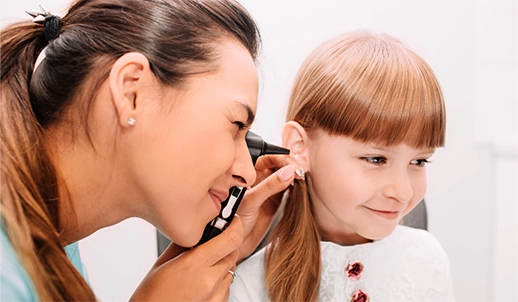
Good hearing is essential for children’s language development. To provide even better and more comprehensive hearing care for young children, scientists at Jade University in Wilhelmshaven are developing a new mobile screening system. In the future, this system is intended for use in settings such as kindergartens, public health departments, and pediatricians’ offices, where it will automatically test children’s hearing in both ears in a child-friendly manner.
Tympanic effusion can lead to middle ear hearing loss
Chronic middle ear hearing loss is diagnosed in 10 to 20 percent of all children examined by the time they start school. It is triggered by cold-related middle ear problems—also known as middle ear effusions—which occur in about 80 percent of all young children. Ear effusions usually do not cause pain. As a result, children may not mention any problems, and a hearing impairment may go undiagnosed. Such hearing problems affect speech development and, consequently, reading and writing skills.
More Comprehensive Hearing Tests Are Recommended
That is why scientists recommend checking the maturity of binaural hearing in children in addition to these standard tests. “Binaural hearing is necessary, for example, to distinguish between acoustic stimuli that carry information and those that are distracting,” explains Katharina Schmidt, a research associate at Jade University. Furthermore, children can only determine the direction of a sound or follow a conversation in a noisy environment if they can hear well with both ears.
Newborn hearing screening has been covered by health insurance since 2009
To detect hearing impairments as early as possible, newborn hearing screening has been covered by statutory health insurance since 2009 and is performed on all infants approximately two days after birth. A second hearing screening takes place during the U8 preventive health checkup in preschool age. This screening determines the hearing threshold—that is, the volume at which a child can just barely perceive a very soft sound.
The new testing system can thus serve as a useful supplement for checking a child’s hearing between these screenings, if necessary.
Read here to find out how you can protect yourself and your children from middle ear infections.
See how good hearing works

How much do modern hearing aids cost?

How is a hearing test conducted?

How do I insert a CIC (Complete-In-Canal) hearing aid?

How do you put in an in-the-ear (ITE) hearing aid?

How do you fit a behind-the-ear (BTE) hearing aid with an ear mold?

How do you put on a behind-the-ear (BTE) hearing aid?