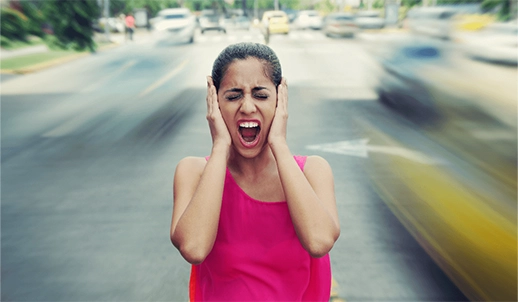
When you hear a loud noise in New York that originated in Dublin
We associate “loud” with the sound of a jet engine taking off, traffic noise, or the rumble of a thunderstorm. However, all of these sounds are downright quiet compared to the loudest sound ever recorded.
When do we perceive a loud noise?
But it’s also surprising just how much noise we’re exposed to in our daily lives. For example, a vacuum cleaner produces about 70 decibels (dB). And a busy street typically produces around 90 dB. Incidentally, this is the range at which we find the noise unpleasant and subconsciously begin to avoid it. As a result, for example, balconies are used less often and windows are kept closed more frequently.

They're so loud…
- Chamber concert, orchestra pit, door slamming: 90 dB
- Music (headphones), wood router, thunder, chainsaw, jackhammer: 95 dB
- Chinese firecrackers, a classical symphony concert: 120 dB
- Car race, jet plane, gunshot: 140 dB
- Blacksmith’s hammer, cannon blast: 150 dB
- Launch of a Saturn V rocket: 204 dB
The loudest animals live underwater
Did you know that it can get pretty loud underwater, too? Because water has a higher density, sound waves don't travel as fast, which is why they reach a higher volume. That's probably also why the three loudest animals live in the oceans.
The pistol shrimp is just five centimeters long, but it can produce a bang of more than 220 dB. This makes it the loudest animal in the world. The pistol shrimp grabs its prey with its left claw, while its right claw snaps shut in less than a millisecond. This creates a shock wave filled with bubbles. It reaches a temperature of 4,700 degrees—as hot as the sun—and thereby incapacitates the prey.
With a sound level of up to 200 decibels, the sperm whale is the second-loudest animal on Earth. It communicates with its fellow sperm whales through clicking sounds. It also uses these clicks to locate prey through echolocation. The sperm whale emits clicks and waits for an echo. Typically, the sperm whale emits two clicks per second. However, once it has located potential prey, this rate can increase to as many as 200 clicks per second.
The third-loudest animal is the blue whale, which is also considered the heaviest and largest living creature. Its song reaches up to 180 dB and can even be heard from a distance of 850 kilometers. Incidentally, the blue whale has extremely keen hearing that extends up to 1,600 kilometers.
Noise-induced hearing loss is irreversible
At around 80 decibels, hearing damage is possible if you’re exposed to the noise for an extended period. When a chainsaw roars, a jackhammer thumps, or an airplane roars overhead, we reflexively cover our ears. 160 decibels are harmful to the human eardrum. The world’s loudest speaker reaches 182 dB, entering a range where sound can actually be fatal to humans. However, it is not the destruction of the hearing apparatus that leads to death, but rather the rupture of the vital alveoli in the lungs, which cannot withstand the sound pressure. Hereyou’ll find additional information from the Federal Environment Agency on noise pollution and noise-induced hearing damage.
To protect your ears from loud noises and prevent hearing damage, you should wear hearing protection or earplugs when you’re in a noisy environment. Noise prevention is important, but it doesn’t have to be expensive. Find out here what types of earplugs and hearing protection are available.
See how good hearing works

Hearing Loss Explained Simply

How is a hearing test conducted?

How do you put on a behind-the-ear (BTE) hearing aid?

Teaser Video Series: Tips & Tricks for People with Hearing Loss

How can you learn to listen properly?

How often do you take a hearing test?

A Flight Through the Ear: Hearing Explained Simply

Hearing Protection for Musicians

Listen. The Meaning of Your Life