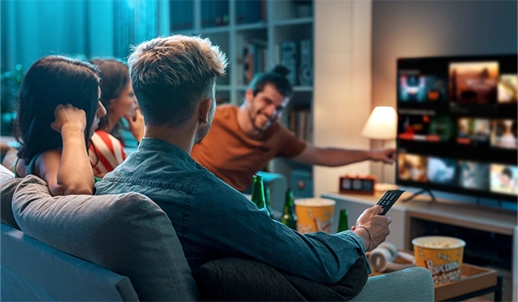
So, since volume, listening time, and headphone use all affect hearing, it’s worth taking a closer look at the hearing health of today’s couch potatoes.

When Things Get Loud After Work
Does your evening sometimes sound like a mini-movie theater right in your ear? When streaming, gaming, and binge-watching, it’s easy to lose track of the volume and how long you’ve been listening. That’s exactly what can be risky. Prolonged use of headphones at high volumes increases the risk of noise-induced hearing loss and ringing in the ears, such as tinnitus.
The combination of habit and convenience is particularly insidious. You turn the volume up a little, you keep listening longer, and your ears get hardly any breaks. Studies by BMJ Global Health and the WHO also show that many audio devices can reach volume levels that are considered unsafe with prolonged use.

Risk factors that are particularly common in the "couch program":
- High volume over extended periods; the risk increases significantly with prolonged exposure at levels of 85 decibels (dB) or higher
- Long sessions without breaks, such as watching several episodes in a row or gaming for hours
- Using headphones in noisy environments, which often leads to unconsciously turning up the volume
- Gaming sound, which, according to the WHO, is often close to permissible limits and may also contain impulse noises, such as gunshots or explosions. These impulse noises can reach critical peak levels of up to 119 decibels.
This is particularly relevant for children and adolescents, as their hearing is still much more sensitive and they often wear in-ear headphones during screen time.
How Much Noise Is Good for Your Hearing?
How much noise is still safe for your hearing, and where does the risky zone begin? Your hearing can tolerate a lot in the short term, but it is sensitive to regular exposure without breaks. International guidelines show that even volume levels perceived as moderate can become problematic during long streaming or gaming sessions. The higher the volume, the shorter your listening time should be. With headphones in particular, the natural warning signal is often missing because the sound enters the ear directly, leading to an underestimation of the strain on your hearing.
Guidelines for Safe Hearing in Everyday Life
| Volume | Example of Use | Load |
|---|---|---|
| 70 dB | A Quiet TV Night via Speakers | Not time-sensitive |
| 75 dB | Smooth streaming or gaming | Several hours are possible |
| 80 dB | Headphones at a moderate volume | Up to a few hours a day |
| 85 dB | Loud video games or action shows | Above this level, the risk of hearing damage increases significantly |
| 90 dB | Very loud sound through headphones | Hearing can be damaged after just 10–15 minutes |
| 95 dB and above | Intense gaming or home theater | Even after just a few minutes, there is an increased risk of hearing damage |
These guidelines illustrate how quickly safe listening times can be reduced. For you, this means:
- consciously adjusting the volume,
- to schedule breaks, and
- to critically evaluate longer listening sessions.

Five Tips for Healthy Listening on the Couch
If you enjoy streaming and gaming, don’t worry. Of course, you shouldn’t have to give them up. What’s more important is being mindful of volume, technology, and duration. Feel free to use our five recommendations:
- Use
devices with volume limits
. Choose devices that provide warning messages or automatically limit volume when it gets too high. These features help prevent you from unconsciously turning up the volume and keep track of your weekly noise exposure. - Apply
the 60/60 rule
A widely accepted rule of thumb in audiology is to listen to audio content at no more than 60 percent of the maximum volume and to take a break after no more than 60 minutes. This simple guideline significantly reduces the risk of noise-induced hearing loss. - Consciously Avoid
Background Noise
People in noisy environments automatically turn up the volume. Those who watch TV shows or play games in a quiet environment can lower the required volume and thus reduce the strain on their hearing. - Take
sudden loud noises seriously when gaming
. Gaming sounds often contain short, very loud peaks. It is precisely these sudden loud noises that can be particularly harmful to your hearing. Reducing the volume of sound effects or adjusting your sound settings can help protect your hearing. - Type of Headphones
Over-ear headphones (which enclose the ear) are often gentler on the ears than in-ear headphones, as they better block out external noise and allow you to listen to music at a lower volume.
What Parents Can Do to Support Their Children's Hearing Health
Parents have a major influence on how safely children use streaming, gaming, and digital media. We’ve already briefly explained that children’s hearing is more sensitive to noise and that habits formed early on have a lasting impact. Even with young children, it’s important to pay attention to hearing protection. At loud events, it’s a good idea to bring appropriate hearing protection. It’s also worth checking how loud your children’s toys are. If necessary, you can remove the batteries to reduce the volume.
You can support your child by agreeing on firm rules for volume and usage time and by activating age-appropriate volume limits on devices. Times without headphones also play an important role—for example, by watching TV together through speakers at a moderate volume. Also, watch for warning signs such as frequent requests to repeat what was said, increasing volume, or ringing in the ears after media use. Regular hearing tests with a pediatrician as part of routine checkups or with an ENT specialist provide peace of mind and help detect changes in hearing early on. This ensures that digital entertainment remains a positive experience for your child without unnecessarily straining their hearing.
If you find that streaming or gaming is only enjoyable at higher volumes, or that listening is becoming more of a strain, it’s worth getting a professional evaluation. Use our free hearing aid specialist and ENT search tool to find qualified professionals near you. An early evaluation supports your hearing health and helps ensure you can continue to enjoy digital entertainment with ease for years to come.
See how good hearing works

Hearing Loss Explained Simply

How is a hearing test conducted?

How do you put on a behind-the-ear (BTE) hearing aid?

Teaser Video Series: Tips & Tricks for People with Hearing Loss

How can you learn to listen properly?

How often do you take a hearing test?

A Flight Through the Ear: Hearing Explained Simply

Hearing Protection for Musicians

Listen. The Meaning of Your Life