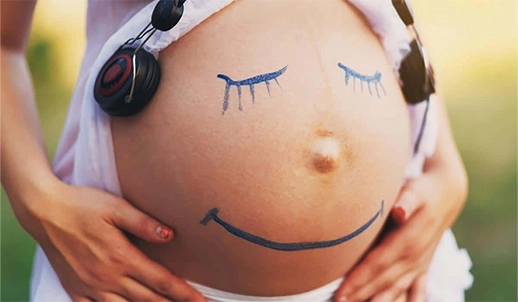
Fascinating facts and amusing insights into the development of hearing in newborns
There is hardly any other sound besides that of a crying baby that can startle women—including those without children—awake. Psychologist David Lewis has discovered that the reasons why men can simply ignore crying children lie in evolution. The Stone Age division of roles still leads women today to react sensitively to sounds that might signal a potential danger to their child. Men, on the other hand, react to sounds that could threaten the entire family. So much for our primal instincts.
In this article, however, we’d like to turn the tables and approach the topic of hearing from the perspective of the very little ones.
At what age can a baby actually hear?
Infants begin learning their native language as early as the first few months of life.
In our article“Good Hearing Shapes Early Childhood Language Development,”we previously reported on a research group from the Baby Language Lab at the University of Konstanz, which concluded that infants can already distinguish many of the world’s 800 languages in the first months of life.
But let’s start much earlier: in the womb, where this little miracle first begins to take shape.
Expectant parents know it well: that recurring excitement and the flutter in the stomach with every new visit to the gynecologist. Will there be fresh ultrasound images, new insights, and confirmation that all the readings are within the normal range and that the new addition to the family is developing as it should?
And anyway—can we already tell whether we’ll need to paint the nursery light blue or maybe pink after all?
Once the first major organs have begun to form, the ear is already visible by the 10th week of pregnancy. Along with the stomach, heart, and liver, it’s the next very important organ, because the sense of hearing should have developed enough by the 23rd week of pregnancy to allow the baby to perceive the first sounds from the environment—and, above all, the mother’s heartbeat.
“The baby hears all the sounds coming from the mother,” says scientist Carolyn Granier-Deferre of the University of Paris. According to her study, starting in the 23rd week of pregnancy, babies can hear their mother’s heartbeat, her stomach rumbling, and the rush of her blood circulation. By week 35, the unborn baby is already able to distinguish between different pitches and recognize speech rhythms, according to psychology professor Fred Genesse of McGill University in Canada, an expert in early language acquisition.
The boom in prenatal support programs began as early as the 1990s
As early as the 1990s, there was a veritable boom in prenatal enrichment programs in the U.S. In addition to exposing the unborn child to classical music in an effort to boost intelligence, there were numerous other programs, such as flashing a flashlight, which was intended to teach the unborn child to count while still in the womb. As you might rightly think—some of this is pretty out there, but let’s keep going…
The Uterus—A Person's First Classroom
Beethoven for the unborn child, or maybe the Beatles instead?
None other than the pioneer of prenatal stimulation from California, Rene Van de Carr, claims to have discovered in his studies that a fetus in its ninth month is capable of adapting its breathing rhythm to Beethoven’s Fifth Symphony if it was played to the fetus regularly during pregnancy. However, since amniotic fluid significantly dampens and distorts external sounds, it’s rather questionable how much actually reaches the fetus. Noise levels in the womb can reach up to 80 decibels—roughly the same as along a busy highway. “Not much of Mozart gets through there—rock music would be better suited,” says neurologist Matthias Schwab of Jena University Hospital. But since an unborn baby naturally sleeps up to 20 hours a day, a constant background noise is likely counterproductive.
Incidentally, research has not yet been able to prove that special stimulation makes unborn children smarter, healthier, more empathetic, or even more musical. So even if you prefer to listen to “YELLOW SUBMARINE” instead of the “Moonlight Sonata,” absolutely nothing stands in the way of your child’s career as a mathematics professor. Well then—rock ’n’ roll!
Speaking of rock 'n' roll:
By the way, rumor has it that Doris Dupree Richards—the very own mother of Rolling Stones guitarist Keith Richards—always loved playing soothing classical music for little Keith while he was still in her womb.
As we all know, the rock idol didn’t exactly grow up to be a wallflower, and—as far as we’ve been able to determine—he never earned a Ph.D. in quantum physics either. There you have it once again… nature follows its own rules, and the miracle of life even more so.
Our most important advice to expectant parents is therefore this: Don’t let yourself get too worried—after all, you’re literally “expecting with joy,” and no matter what your child ends up hearing,… what they love to hear most is just how much you love them!
See how good hearing works

Hearing Loss Explained Simply

How is a hearing test conducted?

How do you put on a behind-the-ear (BTE) hearing aid?

Teaser Video Series: Tips & Tricks for People with Hearing Loss

How can you learn to listen properly?

How often do you take a hearing test?

A Flight Through the Ear: Hearing Explained Simply

Hearing Protection for Musicians

Listen. The Meaning of Your Life