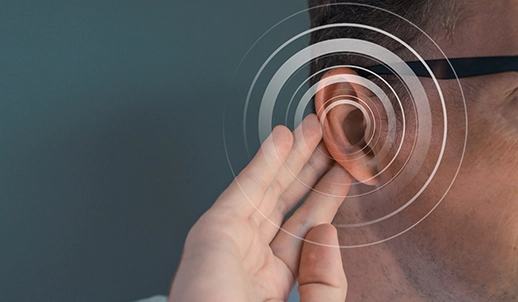
The article explains that the human ear can perceive only a certain range of frequencies—in young people, for example, from 16 to 20,000 Hz. Sounds below that range (infrasound) and above it (ultrasound) remain inaudible to us, while many animals can perceive significantly higher or lower frequencies. As we age, our ability to hear high-pitched sounds in particular declines. Using an example from a Beatles song, the article demonstrates that some high frequencies are barely audible to humans but can be heard by dogs. Furthermore, an anecdote from New York illustrates that perception also depends on attention and personal significance. The article recommends regular hearing tests with a hearing care professional, as online tests cannot replace a professional hearing test.
Can you hear a proverbial pin drop?
In our article “Frequencies & Decibels,” we’ve already discussed that we can only perceive sounds within a certain frequency range: In our younger years, this range extends from about 16 to 20,000 Hz, allowing us to distinguish between approximately 400,000 different sounds. As we age, however, the situation changes, because our ability to hear high-pitched sounds gradually declines.
Generally, three different frequency ranges are distinguished. The range of human hearing is referred to as audible sound. The range below this is called infrasound (below 16 Hz), and the range above it is called ultrasound (above 21,000 Hz)—both of which are inaudible to the human ear. In particular, the human ear cannot perceive very low-frequency sounds in the infrasound range or the extremely high-frequency sounds of the ultrasound range.
Compared to humans, however, many animals can perceive significantly higher frequencies than humans can. Insects, for example, hear very low-frequency sounds below 16 Hz, whose sound waves travel over long distances. On the other hand, hedgehogs, bats, and—leading the pack—dolphins can hear pitches exceeding 100,000 Hz. The vocal range of these animals also varies according to their respective hearing ranges, which only partially overlap with the human hearing and vocal ranges.
Try this test for yourself: listen to the Beatles’ song “A Day in the Life” all the way to the end and pay attention to how your dog reacts. After the final chord, a note with a frequency of about 15,000 Hz is embedded. Most people can no longer perceive this tone—but dogs certainly can. Apparently, the Beatles also had their animal fans in mind when they wrote this song.
Or do we only hear what we want to hear?
Here’s an amusing anecdote about it: “Two friends in the middle of New York: People are jostling, rushing by, talking into their headsets. Bicycles weave recklessly between cars and pedestrians, buses honk, and everywhere there are taxis, screeching tires, and sirens. Somehow, children are playing in the midst of it all, dogs are barking. An unbelievable throng. Suddenly, one of the two friends stops: ‘Hey, wait a minute, can you hear that too? There! A cricket is chirping!’ His friend stares at him in disbelief: ‘A cricket in New York? You don’t really believe that yourself.” The friend steps aside a bit, and sure enough—under a bush by the side of the road: a small brown-and-black cricket with long antennae. “I’m impressed! That you heard a cricket here in the hustle and bustle of New York! Way to go! You must have really great ears!” “Nope,” his friend replies, “my ears are totally normal. But you know, I think you only hear what you want to hear. I’ll show you what I mean.” He drops a coin on the sidewalk—and sure enough, despite the noise, people turn around to see what fell to the ground. “See, you only hear what’s important to you.””
This raises the question of whether we really only hear what we want to hear, or whether our personal frequency range is actually narrower than that of others. We already touched on this at the beginning of the article: Age is often a reason why we don’t perceive certain sounds. But our occupation and gender also influence our audible frequency range.
You can find several online tests in which the participant is played sounds at various frequencies through headphones. If you can no longer hear a sound, it falls outside your audible range. But please keep in mind: These are not professional tests like those performed by a specialist.
That’s why we recommend having your hearing checked regularly—for example, with a hearing test at a hearing care professional near you.
See how good hearing works

Hearing Loss Explained Simply

How is a hearing test conducted?

How do you put on a behind-the-ear (BTE) hearing aid?

Teaser Video Series: Tips & Tricks for People with Hearing Loss

How can you learn to listen properly?

How often do you take a hearing test?

A Flight Through the Ear: Hearing Explained Simply

Hearing Protection for Musicians

Listen. The Meaning of Your Life