Blind biathletes rely on their sense of hearing
Thanks to their sense of hearing, blind biathletes not only navigate the cross-country ski trail safely, but they are also particularly accurate when they hit the right note.
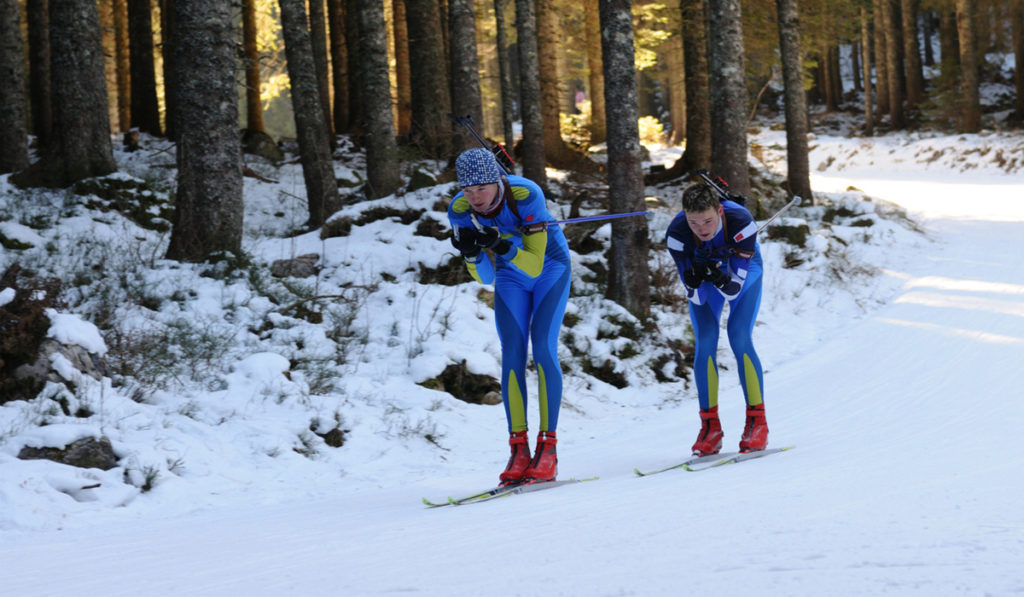
Blind biathlete Verena Bentele and her guide skier Thomas Friedrich are skiing on the cross-country trail; Friedrich skis in front, and Bentele stays behind him. Upon arriving at the shooting range, the skier lies down on her mat, picks up her rifle, and confidently hits the 28-millimeter-wide targets ten meters away. After a total of 7.5 kilometers and two shooting rounds, she crosses the finish line as the winner and claims her 12th gold medal at the 2010 Vancouver Paralympics. Verena Bentele has been blind since birth and owes her extraordinary athletic achievements not only to her physical fitness and mental strength, but also to her ears.
Hearing as a Compass on the Cross-Country Ski Trail
On the cross-country ski trail, blind athletes are guided by their sighted guide. The guide typically skis about two meters ahead of the athlete and continuously provides information about the course. A “hop” can indicate a straight section, and with “left” or “right” followed by a number, the skiers are guided through the turn. The numbers correspond to the numbers on a clock face, so that the blind athletes can use their hearing to estimate the approximate path of the turn.
A loud, continuous tone signals the finish line
And at the shooting range, too, blind shooters rely entirely on their hearing. Unlike sighted biathletes, the rifle has neither a rear sight, front sight, nor scope, and shots are fired not with cartridges but with infrared. The rifle and targets are connected to each other. When the athletes aim at the target, a sound is emitted that becomes higher-pitched and more constant the closer the target gets. When a shrill, continuous tone is heard, the shooter has aimed at the target as accurately as possible and pulls the trigger. A high-pitched ringing confirms a hit. If the target is missed, a dull “boop” sounds.
Blind People Hear More
Various studies
have shown that blind people perceive sounds in their environment with greater distinction, can locate them more accurately, and are better able to distinguish between sound frequencies. This is not only interesting but also practical, since blind people must rely entirely on their hearing in many situations and are therefore all the more dependent on a keen sense of hearing. It is therefore possible to train
our hearing
when we need it most—this applies not only to blind people but also, for example, to professional musicians
.
If you notice any deficits in your own hearing, it’s time for a hearing test
with an audiologist
or an ENT doctor
. Our online hearing test
can also provide you with an initial assessment.
Hearing also plays a crucial role for sighted winter sports enthusiasts. Read more about this in our article “Hearing and Winter Sports.”