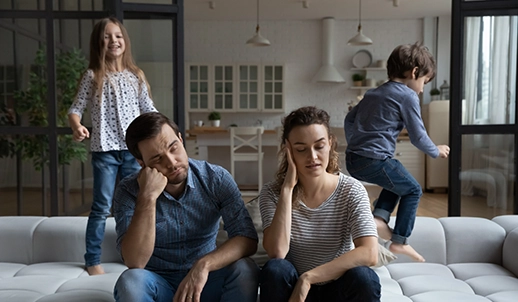
What for children is an expression of joy, communication, and a spirit of discovery often means stress, exhaustion, and a noticeable strain on the ears for parents. Studies show that persistent noise from children not only tests one’s patience but can also affect hearing health. At the same time, one thing is clear: children need to be allowed to be loud in order to test their limits, discover their voices, and find their place in the world.
How can we shape this natural tapestry of sounds in everyday family life so that both children and parents are heard and protected? And how can adults give their ears a break without limiting the important spaces for children’s development? That is exactly what our following article is about.

Why are children loud, and why do they need to be?
Children are loud because they have to be. This is certainly a realization that many parents—who often find themselves caught up in a daily whirlwind of deafening screams, cheerful shrieks, and boisterous play—simply don’t want to “hear” right now. But experts agree: being loud is a natural part of healthy development.
Babies use their voices to survive, because crying is their only means of communication. Later on, making noise becomes an important way to express emotions, develop their own personalities, and experiment with social rules.
Educational studies and developmental research show that children learn to assert themselves within the social fabric by shouting, playing, and experimenting with their voices. Childhood is a space where they are allowed to explore just how much power their voices hold and how they can use them to connect with the world.
For parents, this noise level can be stressful, as children’s voices often reach volumes we rarely experience in everyday life. Still, it’s helpful to know that behind every scream, shout, and shriek lies a developmental milestone. Loud behavior is a natural expression of emotions, needs, and curiosity—and thus an integral part of growing up.

Why Children Are Loud
- A Natural Means
of Expression:
Children express feelings such as joy, frustration, excitement, or tiredness through the volume of their voices, especially when they lack the verbal skills to do so. - Seeking
Attention
: Shouting or screaming is a direct and effective way to get caregivers to pay attention or respond. - Vocal Development and Personality Formation
: Squealing, shouting, or speaking loudly helps children become familiar with their voices and experience a sense of self-efficacy. - Social Orientation
:
Children often use volume to negotiate rules of play, a sense of belonging, and boundaries with their peers. - Imitation of the Environment
If people in their surroundings frequently speak or act loudly, children intuitively adopt this behavior. - Response to Stimuli
: Noisy environments, being overwhelmed, or inner restlessness are quickly reflected in children’s volume levels. - Communication Through the Voice
Babies and toddlers, in particular, use volume to clearly communicate pain, hunger, or discomfort.
How does volume affect parents' ears?
Although children’s noise is below the “pain threshold,” it still reaches levels that are stressful over time. Studies of daycare settings show that noise levels between 70 and 90 decibels are commonplace in such environments. This is a range that can already lead to auditory fatigue, stress responses, and overload. If this volume is exposed to the ears for an extended period, the auditory system reacts with exhaustion, and the body shifts into a state of heightened tension.
For parents, this often means a combination of physical and emotional strain. The inner ear needs regular rest, but in families with young children, breaks from noise are rare. As a result, temporary hearing problems, a sensation of muffled sound, or a slight ringing often occur after particularly hectic days.
Temporary tinnitus can also occur when the hair cells in the inner ear are overstimulated. At the same time, stress levels rise, as the constant background noise fosters nervousness and impairs overall well-being. It becomes particularly difficult when noise persists into the evening or at night, as the lack of rest periods can lead to sleep problems.
In the long term, the risk of permanent hearing damage increases if noise levels regularly exceed 85 decibels and there is a lack of necessary rest. What promotes healthy development in children places significantly greater strain on parents’ ears. That’s why it’s important to keep an eye on your own hearing health and to be mindful of taking time to rest.
How can parents protect their hearing in everyday life?
By adopting a few simple habits, you can effectively reduce strain on your ears and protect your hearing in the long term.
- Create quiet retreats where you and your ears can consciously unwind. This could be another room, a few minutes on the balcony or in the garden, or a short walk outside.
- Schedule regular breaks from noise.
- Set an example for children by showing them what it means to be considerate of noise levels—for example, on public transportation, in a doctor’s waiting room, etc.
- Treat yourself to daily relaxation periods to give your ears a break. Meditation in a quiet environment, for example, is a great way to do this.
- Keep simple hearing protection handy so it’s immediately available when needed—for example, if you need to concentrate briefly while working from home or during certain activities. It’s important that someone keeps an eye on the child or children.
Be aware of how much the noise levels are affecting you, and take action early to protect your hearing health.

4 Tips for a Quieter Kids' Room
A quieter children’s room not only means less stress for parents’ ears, but also helps children switch more easily between activity and relaxation. With a few targeted measures, you can significantly lower the noise level without limiting children’s enjoyment of play.
The following tips show you how to create a comfortable and acoustically pleasant environment with just a few simple changes.
- Consciously Limit
Electronic and Noisy Toys
: Many battery-operated toys or noise-making devices produce continuous sound, making children’s rooms unnecessarily loud. By consciously choosing quieter toys that encourage creativity, you can significantly reduce typical sources of noise. Loud toys that make noises or play music can also strain children’s sensitive ears. Young children, in particular, often hold toys right up to their ears. The volume settings on such toys are frequently not suitable for this. For toys with sound functions, it may therefore be a good idea to deliberately avoid using them—for example, by not inserting batteries. Children will usually still have just as much fun playing with them. - Use
Textiles Strategically for Better AcousticsSoft carpets
, heavy curtains, pillows, and blankets effectively dampen sound while also making the room cozier. Look for high-quality, toxin-free materials so that the room is not only quieter but also healthier. Small nooks with canopies or soft fabrics are particularly effective, as they absorb sound and provide a sense of security. - Creating
Clearly Defined Zones in the Children’s Room
When play, sleep, and quiet areas are clearly separated from one another, both the acoustics and the child’s sense of orientation benefit. A reading or cozy corner with subdued lighting and soft colors automatically signals tranquility. The more colorful, open play area, on the other hand, invites children to let off steam without the noise spreading throughout the entire room. - Establishing
Set Quiet Times and RitualsChildren benefit from clear phases in their daily routine. Set times for reading aloud, drawing, or listening to quiet music help them consciously wind down. If you develop small rituals together—such as a singing bowl, a light signal, or a hand signal for “time to be quiet now”—children will learn in a playful way to better regulate their own volume and be considerate of those around them.
Conclusion
You’re sitting in the living room while your children are happily screaming in the playroom, building blocks are clattering, and their favorite song is playing on repeat. Pure joy for some, an acoustic marathon for others. This is exactly where we see how differently children and adults perceive volume—and why it’s so important to be mindful of it.
It’s clear that children’s noise is a natural part of their development. It’s an expression of emotions, a spirit of discovery, and social learning. But for parents, it often means auditory stress, exhaustion, and the feeling that they can no longer find any real peace and quiet. The good news: There are ways to balance the two.
With simple, practical measures, you can reduce the strain on your ears without taking away your child’s important freedom. Ultimately, it’s not about making children “quieter,” but about creating an environment where everyone can be heard clearly.
If you've already noticed that your hearing is impaired or you're having trouble hearing, you can use our convenient, free search service. It will help you quickly find an ENT doctor or hearing aid specialist near you.
See how good hearing works

Tips & Tricks for Living with Hearing Loss — Episode 1: Talking Openly About Hearing Loss

Tips & Tricks for People with Hearing Loss — Episode 2: All the Things a T-Coil Can Do

How do I insert a CIC (Complete-In-Canal) hearing aid?

How do you put in an in-the-ear (ITE) hearing aid?

How do you fit a behind-the-ear (BTE) hearing aid with an ear mold?

Teaser Video Series: Tips & Tricks for People with Hearing Loss

Tips & Tricks for People with Hearing Loss — Episode 3: Improving Room Acoustics

Tips & Tricks for People with Hearing Loss — Episode 4: Saying What You Need

Tips & Tricks for People with Hearing Loss — Episode 5: Subtitles for All Movies

What are the benefits of hearing aids?

Orientation for People with Hearing Impairments