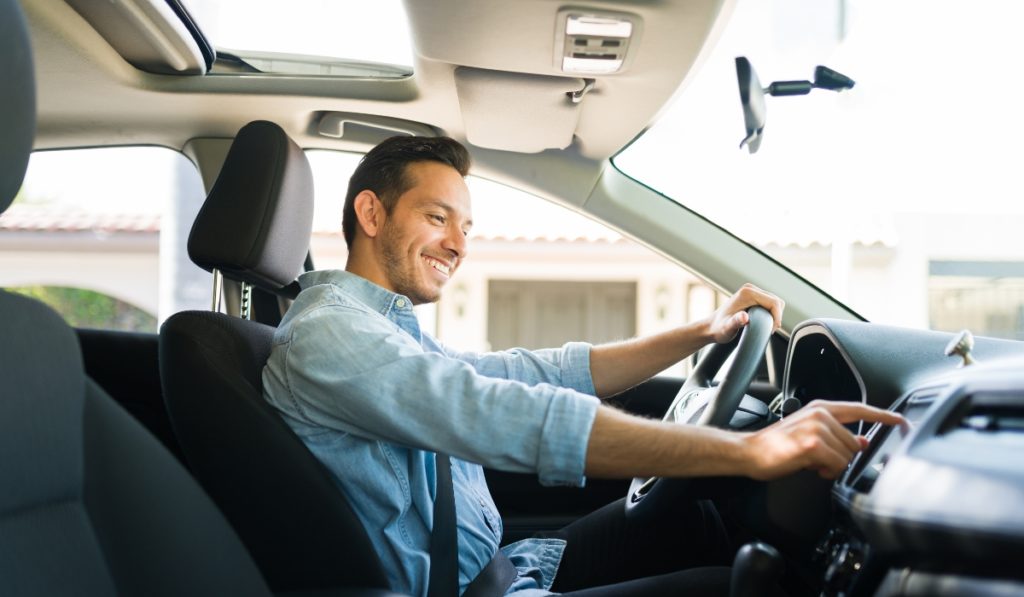
Greater Road Safety
Mobility—for most of us, a high degree of freedom of movement is an essential part of our quality of life. We get in the car, commute to work in the morning, visit family on the weekends, and goon vacation during thesummer months. But what if you have hearing loss? In this article, we’ll show you the role hearing plays in road traffic and whether people with hearing loss are allowed to get a driver’s license.

According to the latest EuroTrak Germany hearing study, 10.9% of German citizens—equivalent to about 9.11 million people—consider their hearing to be impaired. Among those over 74, the proportion is 33.1%.
Can you drive a car if you have hearing loss?
People with hearing loss of 60 percent or more are by no means automatically at a disadvantage when it comes to driving. Starting at a hearing loss of approximately 60 dB in the better ear, driving ability may be impaired, especially for professional drivers. For private individuals (Class B), however, there is generally no driving ban, even in cases of more severe hearing loss or deafness—provided that road safety is ensured.
Why is that? According to the legislature, it is not just the decibel level that matters, but also: speech intelligibility, the ability to perceive warning signals, and the presence of other medical conditions (e.g., balance disorders). The Driver’s License Regulation (FeV) establishes the minimum health requirements for obtaining a driver’s license. Appendix 4 to the FeV addresses “suitability and conditional suitability for operating motor vehicles.” Hearing ability is mentioned therein—though with the note: “Impaired hearing alone does not preclude fitness.”
Hearing loss or deafness is therefore not a general disqualifying factor.
Prerequisite: Road safety must be ensured—for example, through good visual perception (e.g., rearview mirrors, looking over the shoulder) and the absence of other serious impairments, such as balance disorders.
Stricter requirements apply to the professional use of a driver’s license.
For bus and truck drivers, Annex 5 of the Driver’s License Regulation (FeV) stipulates stricter requirements. Significant hearing loss can result in ineligibility in this field, as it is essential to be able to hear acoustic signals such as warning horns or sirens. In such cases, audiometric evaluations (hearing tests) may be required.
73% of people with hearing loss feel safer driving when they wear hearing aids
According to the 2025 EuroTrak Hearing Study, 75% of hearing aid users say they feel safer in urban environments since they started wearing hearing aids.
Directional hearing, in particular, plays an important role in spatial orientation. Thanks to hearing aids, road users—from cyclists ringing their bells to nearly silent electric cars—are more easily perceived, and their distance and direction can be determined more quickly. All of this increases safety and the willingness to remain active in public spaces well into old age—whether on foot, by public transportation, or, as the following slides show, by car, bicycle, or e-bike.
While 66% of drivers who wear hearing aids reported feeling safer in 2022, that figure had risen to 73% by 2025. Among cyclists and e-bike riders, the figure even climbed to 75% during the same period.

The reason is obvious: Hearing aids improve spatial hearing, and those affected feel safer in traffic. Road users can once again pinpoint exactly which direction vehicles are approaching from. This is an essential skill, especially for pedestrians, when cars or e-bikes are not yet in their field of vision.
All the benefits of wearing hearing aids while driving at a glance:
- Improved auditory perception
- Audibility of warning signals
- Recognition of horn signals
- Perception of engine noises
- Increased alertness
- Modern hearing aid features and integration with vehicle technology (connectivity)
Conclusion
Hearing loss does not mean having to give up mobility. Modern hearing aids improve hearing in traffic, enhance the subjective sense of safety, and thus improve the quality of life for those affected.
If you’re not sure how well you can still hear, why not have a hearing test done by an experienced hearing care professional or ENT doctor in your area? Feel free to use our convenient search service. They’ll be happy to assist you with any questions you have about driving with hearing loss and help you find suitable hearing aids.



