
How can we make the day-to-day office experience easier for people with and without hearing loss?
High noise levels in the office often make the workday feel long and stressful. For both hearing aid users and people with normal hearing, daily work should require as little auditory effort as possible. With a few tips and precautions, you can improve the acoustics in the workplace and thus create a more comfortable work environment.
How can the workplace be set up to prevent auditory strain?
Acoustics are extremely important, especially in the workplace, yet they are still neglected far too often. Unwanted sounds and noise quickly become a distraction, which significantly impairs employees’ concentration and sense of well-being. As a result, in the worst-case scenario, work performance can decline.
Whether an employee wears hearing aids or has normal hearing, a workplace should generally require minimal auditory effort. How can this be ensured?
Optimal Room Acoustics and Furnishings
In general, the acoustics of an office space should be designed so that all employees can concentrate and work with as little disruption as possible.
This is particularly challenging in open-plan offices, where there are few or no quiet areas. However, optimal interior design can significantly contribute to noise control and reduction.
First and foremost, it’s important to leave enough space between workstations so that your neighbor’s every movement and activity doesn’t become a distraction.
Furthermore, shelves—ideally filled with books and folders—help reduce noise. This allows you to talk to colleagues without being disturbed, while also helping to shield yourself from the sounds and conversations of other employees so you can work efficiently.
In addition, curtains have a positive effect on noise reduction in the office and also contribute to its visual appeal. Plants can also minimize excessive noise while significantly increasing the sense of well-being!
Plants with large leaves that are placed throughout the room are particularly well-suited for this purpose.
Technical Specifications
Nowadays, modern office equipment operates at significantly lower noise levels, and this is something to keep in mind when making a purchase. Nevertheless, loud devices such as printers, fax machines, or copiers should ideally be placed in a separate room to keep noise levels low. If this isn’t possible, noise-reducing pads for electrical devices can help.
Furthermore, care should be taken to ensure that office chairs and other items do not cause unnecessary noise. To keep noise to a minimum, felt pads on chair legs and casters made of sound-absorbing material are recommended.
Coordinate with Each Other and Be Considerate
To ensure a quiet and focused work environment for every employee, communication and consideration are extremely important.
If you have a phone call or an online meeting, please use a headset or find a suitable quiet space.
Cell phones and answering machines should also be set to the quietest volume possible or switched to vibrate. If you need soft background music to work, be sure to discuss this with your coworkers beforehand!
Employees with (untreated) hearing loss—what should be kept in mind?
People with severe or untreated hearing loss often feel uncomfortable in the workplace. Interacting with coworkers or supervisors and the hectic pace of the workday frequently become challenges and lead to significant stress.
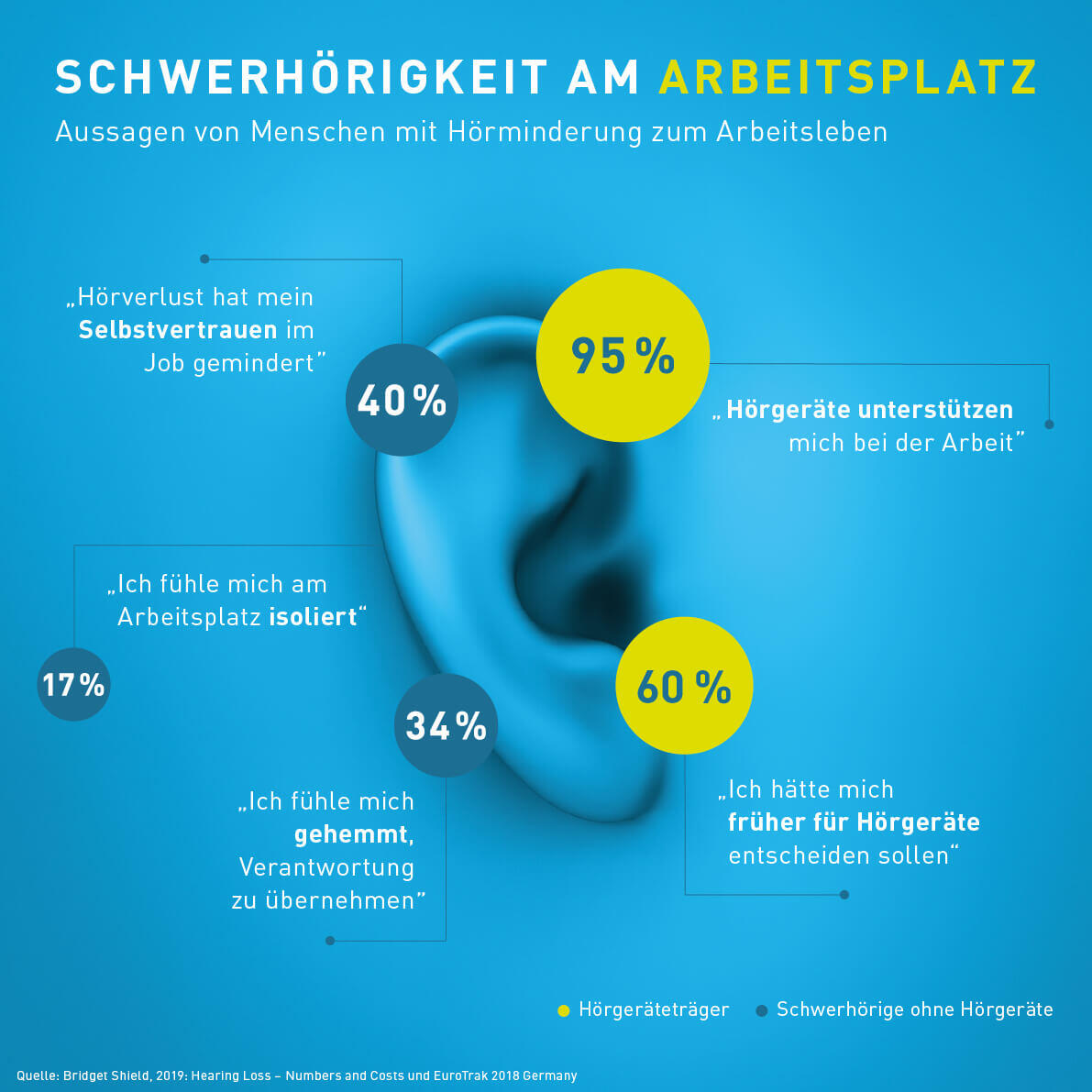
In a 2019 Civey survey, 40 percent of those with untreated hearing loss (i.e., people with hearing loss who do not wear hearing aids) reported reduced self-confidence in their daily work life. Seventeen percent feel isolated at work. Thirty-four percent of people with hearing loss who do not wear hearing aids said they feel hesitant to take on responsibility at work. All of this is preventable!
There are several tips and precautions that can significantly make daily work life easier for employees with untreated or severe hearing loss.
For one thing, workstations with an unobstructed view facing the hallway are helpful. This allows people with particularly severe hearing loss to keep track of the premises and their coworkers.
Furthermore, care should be taken to ensure that alarm signals within the building (such as smoke detectors) include clear visual signals in addition to audible alerts. This ensures that, in an emergency, a person with hearing loss is adequately warned, even if they are alone in a room.
As a general rule, honesty and open communication are essential. Discuss the needs of your hearing-impaired employees with them so that appropriate measures can be taken. It also helps to document what was discussed in writing to ensure there are no ambiguities or misunderstandings on either side.
Do hearing aids improve the situation in the workplace?
95% of people who have received treatment for their hearing loss report that their hearing aids help them at work. In hindsight, as many as 59% would have opted for hearing aids sooner.
The 2022 Eurotrak survey also revealed that 62% of hearing aid users surveyed rate their hearing aids as extremely useful at work.
Furthermore, the survey found that the majority of respondents believe hearing aids increase the chances of people with hearing loss being promoted, finding a suitable job, and earning a higher salary.
If you suffer from hearing loss or suspect you may have it, we recommend that you schedule a free hearing test with a hearing care professional near you.



