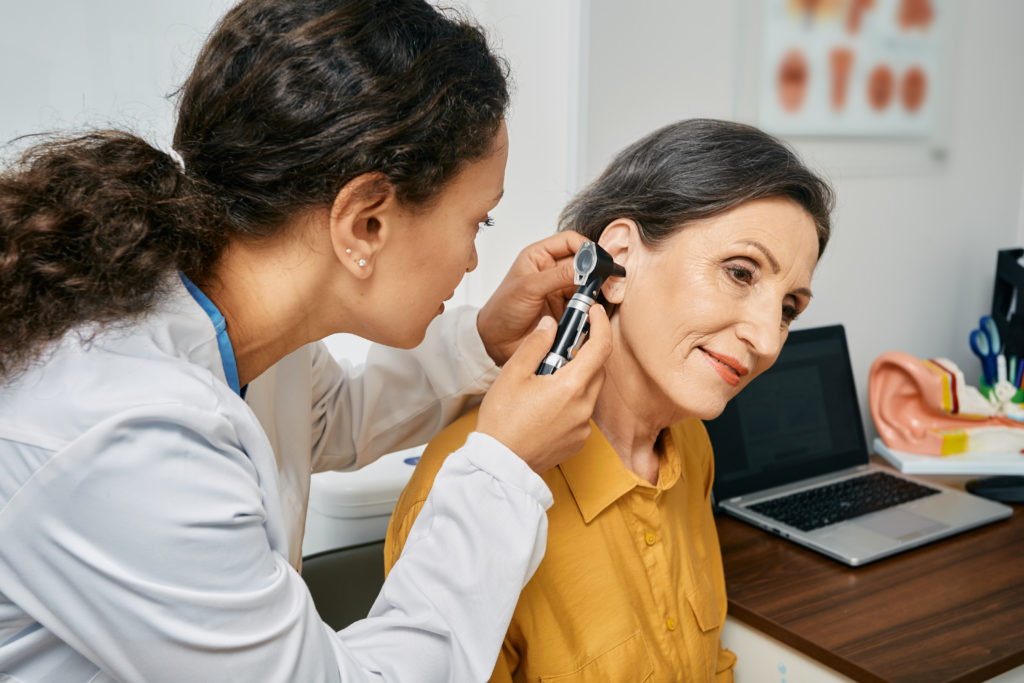
Recognizing and Treating Age-Related Hearing Loss
Starting around age 50, our hearing begins to decline, usually gradually. What you should know about age-related hearing loss—and why the ability to concentrate can also play a role in hearing.
Hearing often declines with age. Starting around age 50, hearing ability can decrease in both ears. One cause of this age-related hearing loss (presbycusis) is wear and tear on the hair cells in the inner ear and damage caused by exposure to loud noise. The auditory nerve and the auditory center can also be affected by the aging process.
Consequences of Undetected Age-Related Hearing Loss
Age-related hearing loss can progress unnoticed for years. This has serious consequences for those affected, their social circles, and the healthcare system as a whole.
- Social isolation: People with hearing loss are at greater risk of becoming lonely.
- Cognitive Decline: Numerous recent studies have examined the link between untreated hearing loss and cognitive decline, particularly in the areas of perception, attention, memory, and the ability to learn and solve problems. The report by the international Lancet Commission, which examined the potential impact of untreated hearing loss in middle age on the later risk of dementia (Livingston et al. 2020), received widespread attention worldwide. The study did not identify a causal relationship.
- Impaired sense of balance: If hearing loss in older adults goes untreated, the sense of balance is often affected.
- Higher risk of accidents: Those affected have more difficulty orienting themselves in space and are at a higher risk of falls and injuries.
- Uncertainties in Everyday Life: People’s sense of safety is diminished. According to their own reports, people with hearing loss who use hearing aids feel safer in traffic than those with hearing loss who do not use hearing aids (EuroTrak Germany 2022).
- High costs to society resulting from untreated hearing loss: Due to its impact on the quality of life and productivity of those affected, untreated hearing loss costs approximately 39 million euros per year in Germany alone (Shield: Hearing Loss – Numbers and Costs. Evaluation of the Social and Economic Costs of Hearing Impairment. Brunel University, London, 2019).
Timely Diagnosis and Fitting of Hearing Aids
Timely diagnosis and treatment are crucial to success. This is because people with hearing loss in middle age quickly get used to new hearing aids. Their ears and brains haven’t yet “forgotten” how to hear and can adapt flexibly to hearing aids. The situation is quite different for people aged 70 and older. Older patients and people who have had hearing loss for a long time have often literally “unlearned” normal hearing. In such cases, adjusting to hearing aids is usually more difficult, and more patience and perseverance are needed for successful treatment, as the brain must first gradually get used to the new hearing solution.
Get Regular Hearing Tests
Starting at age 50 at the latest, you should have your hearing tested regularly—that is, at least once every two years. Hearing tests can be performed by an ENT specialist or hearing care professional in your area. The World Health Organization (WHO) also recommends hearing tests and early intervention for hearing loss in older adults to prevent cognitive decline in later life. The German Professional Association of Ear, Nose, and Throat Physicians (BVHNO) and the Federal Association of the Hearing Aid Industry (BVHI) jointly advocate for hearing screenings by an ENT specialist starting at age 50, which are covered by health insurance for those with public health insurance.
The Ability to Concentrate Affects Hearing
As people age, not only does their hearing decline, but so does their ability to concentrate. Scientists at the Max Planck Institute in Leipzig have demonstrated that older participants find it more difficult to maintain concentration and focus on what is essential in the presence of background noise and in challenging listening situations. They were also more easily distracted from listening by visual stimuli than younger participants. The scientists’ interpretation: The older we get, the more strenuous hearing becomes. Concentration exercises can help here.
How can you improve your concentration?
With these concentration exercises, which are easy to incorporate into your daily routine, you can boost your performance. They strengthen your mental stamina and can also improve your hearing.
- Memorizing phone numbers or birthdays
- Recite and memorize poems
- Mentally create and remember a shopping list
- Count the months backward
- Spelling words backward
- Keep a diary
- Writing mirror-image
- Read regularly
- Meditation
There are many other ways to train your ability to concentrate. Just try out different concentration exercises.
Tips for Improving Your Concentration
Here’s how to improve your ability to concentrate effortlessly:
- Do exercises that you enjoy.
- Alternate mental exercises with physical exercises—such as those you’re familiar with from your sports group.
- Play board games with your family or in regular groups.
- It’s better to do several short concentration exercises than one long one.
Our online hearing tests give you an initial idea of how well you can hear. Just give them a try—it only takes a few minutes.

Gut hören – gute Eingewöhnung mit Hörgeräten
Hörgeräte sollten im Alltag wie eine zweite Haut sitzen. Wir zeigen, wie Ihr Hörgerät im Alltag zum unkomplizierten und perfekten Begleiter wird.

Spiel & Spaß mit Hörgerät
Ein gemeinsamer geselliger Abend voller Freude und Gelächter: Spielabende sind unter Jung und Alt gleichermaßen beliebt. Ob ein klassisches Gesellschaftsspiel oder die neuste Spielinnovation – neue Technologien ermöglichen Erleichterungen auch für Hörgeräteträger. Von Hörgerät-kompatiblen Spielen bis hin zu Brettspielen, die ein spielerisches Hörtraining ermöglichen, kommen immer mehr Spiele auf den Markt, die speziell Menschen mit […]
Mein neues Gadget zum Telefonieren, Konferieren, Chatten und Hören
Schlecht Hören, das tun doch nur Alte. Dachte Hans Frenken auch, bis er sich zu Hause immer öfter verhörte, häufig nachfragen musste und in Webkonferenzen Kopfschmerzen bekam. Doch dann kam er ganz einfach zu digitalen Hörgeräten.