Did you misjudge your hearing ability? There's no reason to be embarrassed!
“You can’t hear well!” “No, my hearing is just as good as it used to be!”—that’s what many people believe. However, hearing tests show that this is a misconception, because hearing ability declines with age. What can you do?
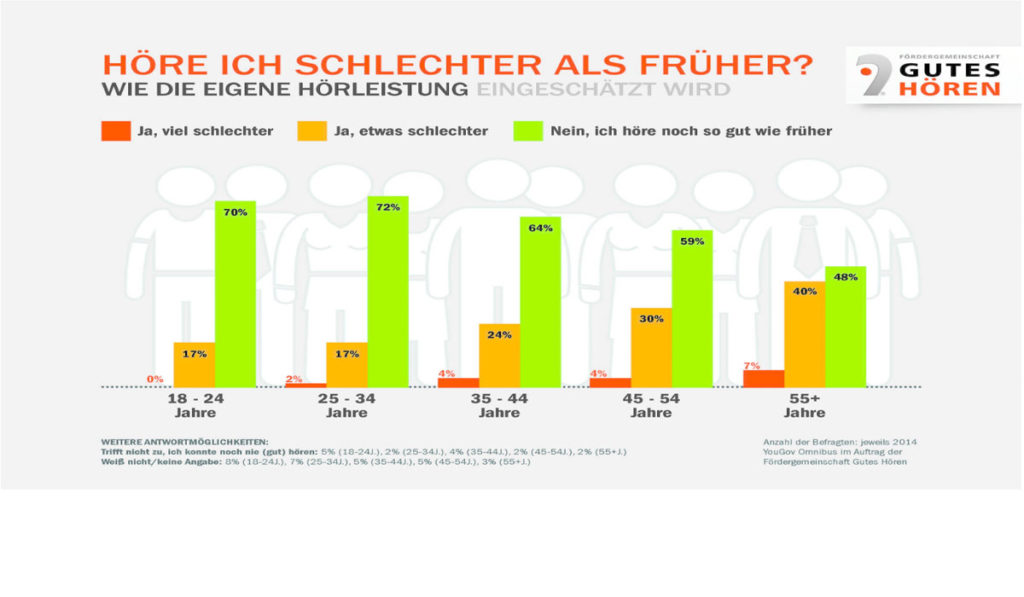
“Pardon? Could you repeat that? What did you say?” Do your parents, grandparents, or partner ask these questions more and more often? When you gently try to let them know that their hearing isn’t as good as it was a few years ago, you naturally get the response: “I hear everything I want and need to hear—just as well as I used to!” That’s what most people hear—and, above all, what they believe about themselves. According to a representative survey by the Fördergemeinschaft Gutes Hören (FGH), nearly half of all respondents in the 55+ age group rate their hearing as good. Among 45- to 54-year-olds, the figure is just under 60 percent, and among 35- to 44-year-olds, 64 percent believe they hear well. But is that really the case?
Self-assessment of one’s own hearing ability is often a fallacy
As the FGH also demonstrates, many respondents overestimate their hearing. This is shown by hearing test results from the annual surveys conducted by the FGH throughout Germany. According to these results, among those over 60, only 16 percent of all participants had normal hearing, 34 percent had mild hearing loss, and about half of all hearing test participants were found to have moderate to severe hearing loss. As you can see, your assessment that your loved ones’ hearing has indeed deteriorated is likely spot on.
When Sounds Simply Disappear—Recognizing Hearing Loss
But why is it so hard for those affected to realize on their own that their hearing has deteriorated? With hearing loss, the sound doesn’t just suddenly disappear. Hearing loss usually creeps up gradually; this is also true of age-related hearing loss, which, by the way, is the most common form of hearing loss. In such cases, those affected often first notice that they’re having trouble hearing high-pitched sounds—especially when the environment is noisy. And because the sounds and tones simply fade away, they don’t even notice that something is missing. This is quite different from vision loss, where we usually realize immediately on our own that we can no longer see something clearly. Some people may suddenly find that their arms aren’t long enough to reach the text while reading, or that they can no longer make out the poster across the street, no matter how hard they squint.
Do you repeatedly notice that your parents, grandparents, or other relatives either ask for clarification or—and this is the clearer warning sign—withdraw from larger group conversations, simply stop speaking, and sit on the sidelines, uninvolved, at family gatherings? If so, it’s strongly recommended that you take action. In our article “What to Do If Mom, Grandpa, or Your Partner Has Trouble Hearing,” friends and family will find tips for dealing with hearing loss.
To prevent this, experts recommend regular hearing checkups—for example, by taking a hearing test at a hearing care professional near you.



