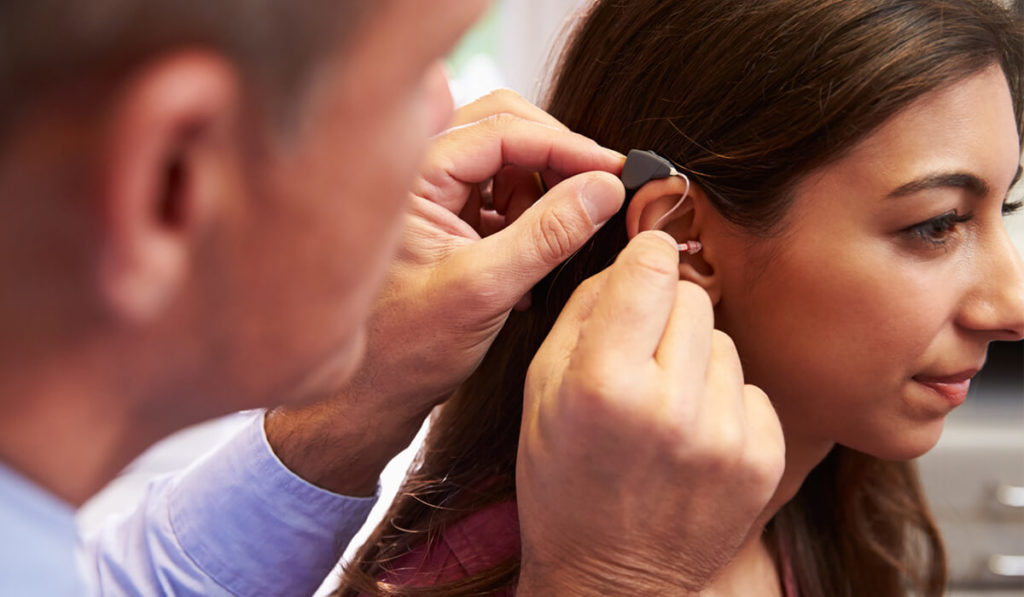
The new job board on this website features current job openings for hearing care professionals. Maybe your dream job is listed here? Hearing care professionals—formerly known as hearing aid specialists—are in high demand. They can help people with hearing loss enjoy life to the fullest and experience the pleasure of hearing.
As understanding professionals who help people with hearing problems, they play an important role—and not just for those affected. Given the steadily growing number of people with hearing impairments in Germany, this career path offers excellent long-term prospects. At the same time, the job is modern and varied.
No two cases of hearing loss are alike
Hearing loss can range from mild to complete deafness and can have a variety of causes affecting the entire auditory system. For the hearing care professional, therefore, the first priority is to identify the type of hearing loss.
This process begins with a personalized consultation and a free hearing test—that is, an audiometric evaluation. The goal of the consultation is to understand the patient’s personal hearing situation and individual needs. What is their daily listening experience like? What professional challenges do their ears have to cope with? What are their leisure activities—such as meeting friends, watching TV, going to the theater, or playing sports?
The hearing test that follows doesn’t take long and provides insight into your hearing ability. During the test, you sit in a specially equipped room. Tones are played through headphones. Based on your responses, the audiologist creates a personalized hearing curve. The results of the hearing test form the basis for further in-depth personalized consultation and treatment.
Always at the cutting edge of technology
Thanks to rapid technological advancements in hearing aids, hearing care professionals are always up to date on the latest developments in apps, transmission standards such as Bluetooth, connectivity, and artificial intelligence for hearing aids. This makes the job technically diverse and cutting-edge. Hearing aid specialists are knowledgeable about electronics. Anyone interested in this profession should therefore also have a good understanding of mathematics and physics.
Today’s hearing aids are packed with technical features and therefore resemble microcomputers more than traditional hearing aids. The challenges encountered during the hearing aid fitting process are also addressed using the latest technical equipment and available expertise. To do this, the hearing care professional uses software to measure what actually reaches the client’s ear and customizes the hearing system’s settings to the client’s individual needs. Actual hearing ability is regularly reassessed during follow-up visits, and the software is reconfigured accordingly. This fine-tuning of the hearing aid is also part of a hearing care professional’s responsibilities.
Already today, digital technology in particular has created countless options for customizing hearing aids to correct hearing impairments on an individual basis. Technological advancements will continue in the future and offer even better solutions for people with hearing loss, which hearing care professionals will recommend and customize for each individual.
What qualifications should a hearing aid specialist have?
Hearing aid specialists are experts in electronics, anatomy, audiometry, and psychology. Their manual dexterity and technical expertise make them highly sought-after specialists in the healthcare field and, as a result, indispensable partners for ENT physicians.
This video on the website of the Federal Guild of Hearing Aid Specialists (biha) provides a good overview of this broad field of work. As a technician, a hearing aid specialist needs a great deal of tact and a passion for working precisely with technical equipment. Hearing aids are not one-size-fits-all products; rather, they are customized for each individual client.
To do this, an earpiece—known as an otoplastic—must first be fabricated. This is a custom-fit piece created using an acrylic mold. The hearing care professional shapes this hardened acrylic mold to perfection through drilling, milling, and sanding. In addition to technical and manual skill, this requires a great deal of care and attention to detail. Hearing aid specialists work with intense concentration and great precision. Even during routine maintenance of hearing aids, they replace the tiniest components and clean individual parts.
At the same time, the profession of hearing aid specialist requires a great deal of tact and, above all, a genuine enjoyment of working with people. When speaking with clients, it’s important to build trust so that they can describe their concerns openly and honestly. Good hearing aid specialists advise their clients like best friends and are fully committed to providing the best possible hearing care.
This also includes caring for patients who have difficulty expressing themselves or can hardly express themselves at all. As part of their training, hearing aid specialists receive psychological training so they can provide patients with dementia and children with optimal hearing systems. It is important to take plenty of time with these patients. This is because people with dementia do not always respond immediately. Emotional connection is also of great importance. Attentive eye contact, a friendly smile, and perhaps even a gentle touch on the hands or arms can help establish a connection.

What makes a good hearing care professional?
This checklist will help you find the right hearing care professional and also highlights the skills that are essential for this profession.
- Professional Expertise
The human ear and hearing aid technology are their area of expertise and passion. This includes explaining hearing problems to clients in a way they can understand and outlining the steps involved in the fitting process. They are eager to continue their education, stay up to date on the latest technical developments, and strive to provide their clients with the best possible hearing aid solutions.
- Patience
The trial period with new hearing aids can take some time. It usually takes several appointments with the hearing care professional before the settings are just right and the wearer feels truly comfortable. However, clients should never feel like they are being a bother. It should also be possible to test different hearing aids in everyday situations. This is because they often differ significantly in sound quality and adjustment options. Patience, understanding, empathy, and a personalized approach to addressing clients’ wishes and concerns are the hallmarks of a good hearing care professional. A calm and composed demeanor when interacting with clients goes without saying.
- Precision
Hearing care professionals are skilled technicians who work with great care and focus. They take pride in precision and perfection. When checking that a hearing aid fits correctly, keen observation and a delicate touch are also essential.
- Understanding of the Natural Sciences
In their day-to-day work, hearing aid specialists often have to calculate formulas and analyze technical data. Knowledge of math and physics is essential for hearing aid specialists to select a perfectly functioning hearing aid for each of their clients. In addition, hearing aid specialists must be able to use professional-grade equipment to analyze frequencies and sounds.
- Initiative
Hearing aid specialists work independently and provide individualized care to their clients. This requires initiative and the ability to make decisions, as the hearing aid specialist is solely responsible for fitting the ideal hearing aid. Finally, in addition to technical knowledge, business skills are necessary for pricing and billing.
Training to become a hearing aid specialist is a dual program, consisting of on-the-job training and block sessions at a vocational school, and is offered at only a few locations in Germany. It lasts 3 years and can be shortened to 2 to 2.5 years. No specific educational background is required; in practice, however, companies primarily hire trainees with a secondary school diploma or a high school diploma qualifying for university admission.
At the end of the training program, trainees take a practical, written, and oral journeyman’s examination. Those who pass this exam are authorized to call themselves state-certified hearing aid specialists. Afterward, they work either in a hearing aid retail store or for hearing aid manufacturers.
Training to become a hearing aid specialist also offers the opportunity to pursue an academic career at the Campus Hörakustik in Lübeck—even without a high school diploma. After passing the master’s examination, you can take the step toward self-employment. In addition, numerous continuing education programs and specializations are available, such as pediatric audiology (audiology for children).
In the hearing aid technician trade, apprentices usually already have a signed employment contract in hand by the time they take their journeyman’s exam—often with the same company where they completed their apprenticeship. For young people who have a strong interest in technology, a knack for hands-on work, and enjoy interacting with people, this profession—with its excellent future prospects—may be just the right fit.
How exactly does a hearing test work? Here you can see what happens during a hearing test and learn how the examination at the hearing care professional’s office is conducted