Youth Researches
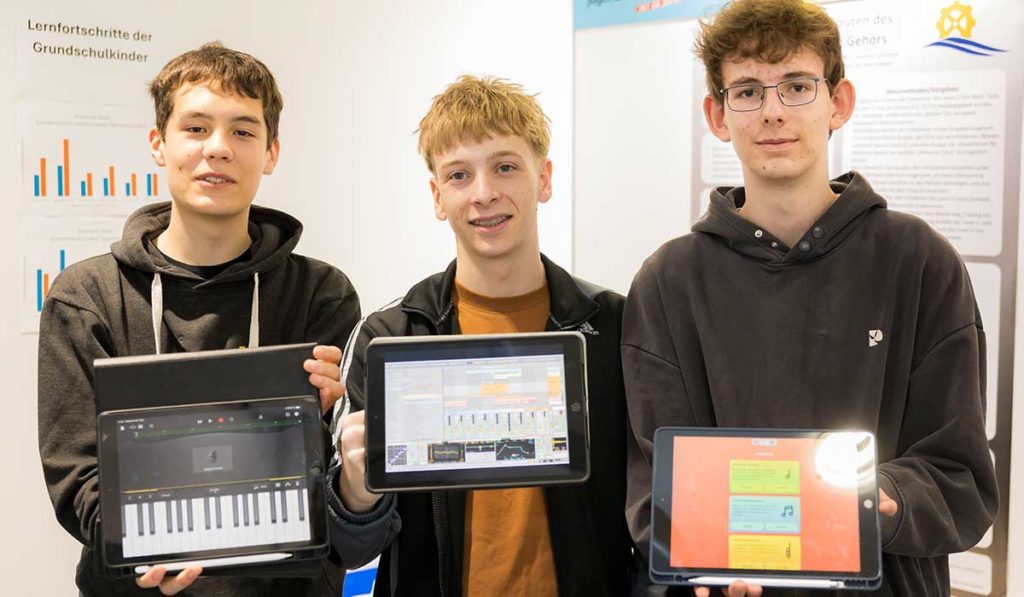
What does it take to accurately identify sounds without a reference—and can this be learned? Young researchers Leontin Schmidt, Carlos Toshiro Beato del Rosal, and Noah Wieder explored this question in an exciting project at “Jugend forscht” 2025. For their work, they received the Special Award from the German Hearing Aid Industry Association.
Leontin Schmidt (17), Carlos Toshiro Beato del Rosal (16), and Noah Wieder (17) attend Steinmühle High School in Marburg, a high school with a mandatory full-day program. Together, they developed the project “In Search of Perfect Pitch” as part of the “Jugend forscht” science competition: In their project, the three researchers explored the phenomenon of perfect pitch. They wanted to find out whether anyone can learn this skill and what factors influence the learning process. We spoke with them about their motivation and their approach.
In your project, you explored perfect pitch. How did you come up with the idea?
“The idea arose from our fascination with perfect pitch and the latest scientific findings on the subject. Surprisingly, there is still very little research in this area. It was also particularly motivating that our group member Toshi himself has perfect pitch.”
"This made us curious about how perfect pitch develops and whether it might even be possible to learn it. The rarity of the phenomenon and the evidence pointing to possible influencing factors, such as early musical training or learning tonal languages, also piqued our interest."
What is perfect pitch?
Perfect pitch is a rare ability that allows a person to accurately recognize and identify sounds without any point of reference. In Europe, it is estimated that only about one in 10,000 adults possesses this so-called passive perfect pitch. Even more extraordinary is active perfect pitch—people with this ability can, for example, sing melodies directly from sheet music without the aid of an instrument. You can learn more about this in our article“Perfect Pitch.”
What personally fascinated you about this topic? Do any of you play an instrument, or do you have a musical background?
“We were fascinated by the fact that perfect pitch is a skill possessed by very few people and that it lies at the intersection of genetics, neurobiology, and environmental factors. We found the question of whether and how this ability can be fostered or even specifically learned particularly intriguing. After all, perfect pitch is often viewed as an innate gift. Yet, in fact, it is not known to what extent—or even whether—a genetic component plays a role at all.”
There is even evidence suggesting that the development of this ability is strongly correlated with early childhood music education. We all have some prior musical experience from playing a wide variety of musical instruments; Toshi, in particular, has been playing the piano since he was seven years old.”
How did you go about conducting your tests and experiments?
“We conducted a study involving a total of just under 90 participants, including classmates, teachers, friends, and family members. We developed various tests to examine relative and absolute pitch. To do this, we used sound and audio recordings we created ourselves, which were generated with a synthesizer and/or music software.”
Participants were asked to identify a specific note among others and write it down, with the difficulty level varying based on previous results. The tests were conducted at a steady pace over several days. When evaluating the results, we placed particular emphasis on various parameters—such as age and prior musical experience—that could potentially influence perfect pitch.”
What was the most exciting or surprising thing you discovered while analyzing the data?
“Contrary to our initial expectations, factors such as gender and the distinction between tones and sounds played virtually no role. In addition, participants with a strong musical background—those who had been playing an instrument since childhood—achieved significantly better results. Most notably, however, our younger participants showed far greater progress in learning. This once again indicates that age plays a decisive role in the development of perfect pitch.”
What are the main findings of your study?
"From our perspective, there are four key findings:
- Perfect pitch is extremely rare and depends primarily on early musical training.
- The likelihood of developing perfect pitch is highest during prepuberty.
- Prior musical knowledge and constant practice promote relative pitch and the ability to recognize instruments.
- According to our findings, acquiring perfect pitch in adulthood is very difficult, if not impossible.”
Have any interested parties from industry or academia approached you yet?
“So far, we haven’t received any direct inquiries from industry or academia. However, our project was presented as part of the ‘Jugend forscht Hessen’ competition. We hope that our findings will spark the interest of researchers or music educators and perhaps lead to further collaborations.”
You’ve successfully carried out a wonderful project with “In Search of Perfect Pitch.” Thank you very much for the nice conversation, and best of luck with your future projects!
From catchy tunes to hearing colors to ringing in the ears—human hearing produces fascinating sensory experiences that aren’t always pathological. What many people mistake for tinnitus often turns out to be a harmless but intriguing phenomenon of our auditory perception. Learn more in the article “Phenomena Related to Hearing.”



