A playful exploration of the topic of hearing: At the Deutsches Museum’s Hearing Workshop in Munich—as the name suggests—everything revolves around hearing. As one of the largest museums of science and technology, the Deutsches Museum uses interactive elements to educate its visitors about how hearing works, the remarkable capabilities of our sense of hearing, and the importance of protecting it from excessive noise. Fascinating experiments explain the wonder of hearing.
Hear, hear!
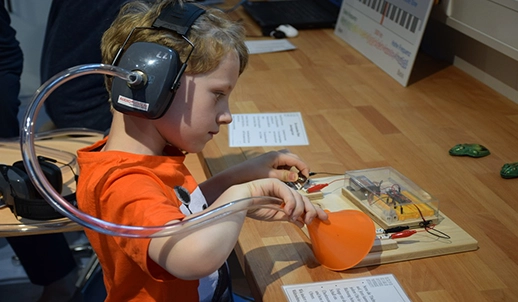
How did composer Ludwig van Beethoven perceive his music, even though he was deaf? At what point does noise become harmful to the ears, and what can you do if your hearing no longer works properly? Visitors can experience what our hearing is capable of and what modern technology—such as hearing aids and headphones—can do in the Deutsches Museum’s Hearing Workshop. Through various experiments, children and adults learn more about how hearing works and how modern hearing systems assist people with hearing loss. They experiment with ringing coat hangers, test noise-canceling headphones, measure the volume of music from an MP3 player, and explore how music can be transmitted through light.
"Hör-Werkstatt" Hands-On Area
Whether it’s airborne or structure-borne sound, directional hearing, noise, noise protection, assistive devices for hearing loss, cochlear implants, or vinyl records: The Deutsches Museum’s Hearing Workshop has answers to many questions about hearing, how the ear works, hearing loss, and hearing aids. Visitors of all ages—10 and up—can embark on a journey of discovery through the human ear. Participation in the workshop is available at any time and is included in the museum admission.[/vc_column_text]
Hands-On Physics
Visitors will find the Deutsches Museum’s Sound Workshop as a hands-on area right in the middle of the museum’s physics exhibition. The Sound Workshop program is part of the Experiment Workshop, which brings everyday physical phenomena and high-tech concepts to life through creative and often astonishing experiments, as well as by letting visitors tinker with their own projects. It appeals to all museum visitors and also offers bookable programs for school classes and groups.
How can you protect your hearing from noise?
The Hearing Workshop shows that our hearing is capable of extraordinary feats. That’s why we should protect it from noise as best we can. It’s nearly impossible to avoid noise entirely, since there’s always construction, driving, partying, or flying going on—and all of that causes noise. So what helps? In addition to smart urban planning with low-noise asphalt or landscaped quiet zones, hearing protection often helps. For DIY enthusiasts or those seeking an undisturbed night’s sleep, simpler, standard solutions from a drugstore or pharmacy are usually sufficient. For hobbies like motorcycling, specialized hearing protection is available from a hearing care professional. And when listening to music through headphones, remember: listen wisely!
Keep your eyes open and listen
Anyone who still hasn’t had their fill of the fascinating human body after visiting the Deutsches Museum’s Audio Workshop can explore it further in the “Health” exhibition. Here, visitors can see and experience how pharmacy and medical technology have been helping people for centuries. Starting with the teeth, eyes, and ears, the exhibition moves on to the cardiovascular system and then to the limbs and joints. Visitors literally embark on a journey into anatomy: a gigantic body fills the room, featuring a walk-through head, an open-air rib cage framework, hand and leg silhouettes on the floor, and a 5-meter-tall foot. Also featured: our senses, including hearing. Visitors can try out whether they hear better with a historical ear trumpet. By comparison, modern hearing aids and cochlear implants are small technological masterpieces.
The Deutsches Museum’s Hearing Workshop raises awareness about hearing, hearing impairment, and hearing loss. If you’d like more information or feel that your hearing is impaired, please consult your ear, nose, and throat (ENT) doctor or a hearing care professional in your area.
See how good hearing works

Hearing Loss Explained Simply

How is a hearing test conducted?

How do you put on a behind-the-ear (BTE) hearing aid?

Teaser Video Series: Tips & Tricks for People with Hearing Loss

How can you learn to listen properly?

How often do you take a hearing test?

A Flight Through the Ear: Hearing Explained Simply

Hearing Protection for Musicians

Listen. The Meaning of Your Life