Audiologist Provides Hearing Aids to Children with Hearing Loss in Uganda
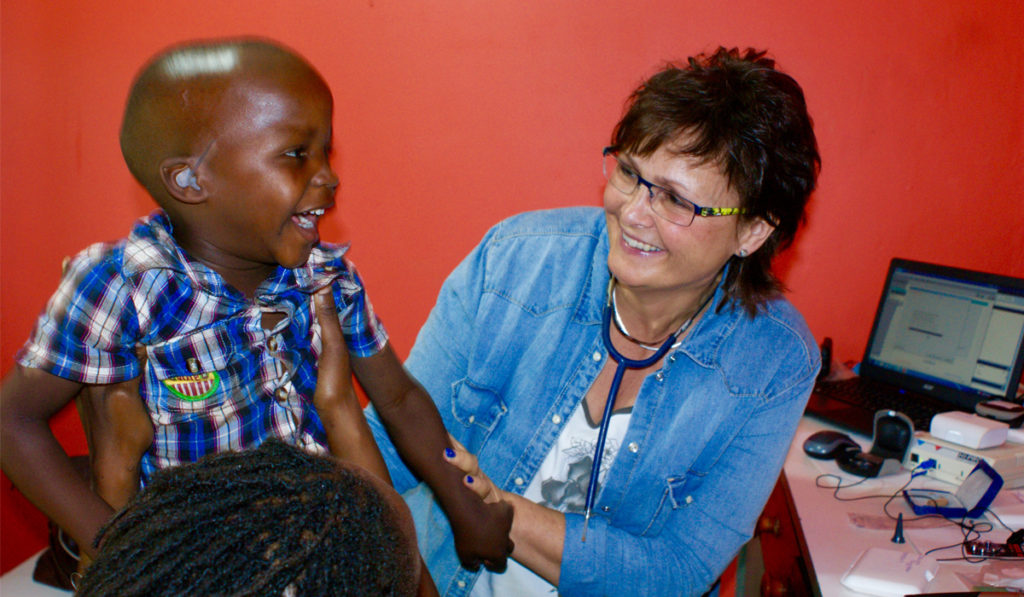
“When children hear their own voices for the first time, it gives you goosebumps”—these moments are what drive Heike Nörenberg’s work in Uganda.
For 10 years now, the master hearing aid specialist from Hagenow has been running an aid project in Uganda that provides hearing-impaired children with hearing aids and offers them ongoing support. It’s a cause close to her heart: because hearing-impaired children there often face exclusion and social disadvantage.
Common Causes of Early-Childhood Hearing Loss
Early childhood hearing loss is widespread in countries with inadequate healthcare. As devastating as the consequences of untreated hearing loss are for these children, a sustainable supply of hearing aids is just as essential. This is because functional hearing is of paramount importance for children’s educational success and their future opportunities in the job market and in society.
Heike Nörenberg tells us about a boy named Maliik. He developed completely normally until the age of 2, when he contracted malaria. Treatment with strong antibiotics damaged his inner earand caused severe hearing loss. This makes Maliik a typical example of the progression of hearing loss among many children in Africa. If hearing is damaged by infectious diseasessuch as malaria or meningitis—or by their treatment—there is usually no help available. This is because families simply lack the money to treat hearing loss—let alone to pay for the necessary hearing aids and regular follow-up care.
Sustainable Care: A Matter Close to Our Hearts
The crucial question before launching the project was how to ensure that assistance could be provided on a long-term basis. Simply distributing hearing aids to the children is not enough. Ongoing maintenance is required, such as regular battery changes. In addition, sound tubes must be replaced and minor repairs carried out. Follow-up audiograms(hearing tests) are also necessary.
Support Even After Hearing Aid Fitting
To provide the best possible care for the children, the ear molds are custom-made on site. In addition to the technical aspects, however, the goal is also to address speech deficits. “Children with severe hearing loss who are hearing with hearing aids for the first time cannot immediately speak like their hearing peers, who learned to speak automatically through listening. The children need to practice a lot and receive professional speech therapy,” explains Heike Nörenberg. To this end, she collaborates with special education teachers and two local special education schools, training them in audiometry, ear mold fabrication, and hearing aid fitting. Children who cannot be helped with hearing aids receive sign language instruction.
Maliik Gets a New Lease on Life
When Maliik received his first hearing aids, he suddenly burst out laughing—he could hear! When he then repeated “papapa,” his father had tears of joy in his eyes. With his hearing aids, Maliik can learn to speak, communicate with his parents and friends, and understand everything at school—in short, he has the chance to take his place in life.
For more information about the project, visit www.hoerakustik-noerenberg.de.
We highlight additional aid projects for children with hearing impairments in our article “Hearing Aids for the World.”