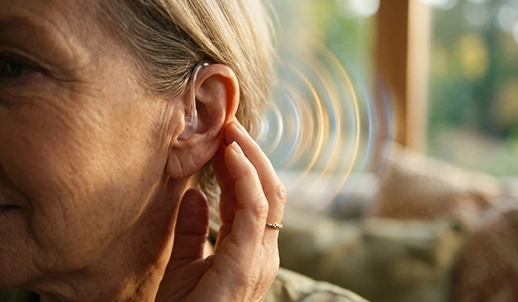
A good conversation, familiar voices, the laughter of friends—hearing means quality of life. Modern hearing aids are capable of amazing things today and open up new worlds of sound. To fully experience these, a little practice is needed. Audiotherapy helps you specifically train your hearing and confidently process new auditory impressions.
What is audiotherapy?
Audiotherapy is a holistic form of hearing rehabilitation aimed at improving hearing and comprehension, as well as helping individuals cope with hearing loss. Audiotherapy goes beyond individual training exercises and combines various components that work together to strengthen hearing ability in everyday life.
An important component of audiotherapy is hearing training. Through this, individuals learn
- distinguish between sounds,
- understand speech better,
- and get used to new auditory experiences.

The added value becomes particularly clear after receiving hearing aids or a cochlear implant: The technology provides new or altered auditory experiences, and our brain must first learn to process and interpret them meaningfully—which is where hearing training comes in.
You can find more information about hearing training here.
Auditory therapy, however, goes one step further. In addition to auditory training, it includes:
- Counseling
- Communication strategies
- Support in everyday life
In this way, audiotherapy not only strengthens hearing itself but also helps individuals navigate various listening situations with confidence. The goal is to sustainably improve the quality of life for people with hearing loss and help them gain greater confidence in their daily lives.

Why is speech therapy important?
Many people underestimate the fact that good hearing does not depend solely on hearing technology. Hearing means understanding information, following conversations, and navigating complex listening situations. Without targeted assistance, it’s possible that sounds may be heard despite technical support but not processed correctly. This is especially true in noisy environments or when multiple people are speaking.
When understanding is difficult, many people with hearing loss often unconsciously withdraw from conversations. Audiotherapy helps people regain confidence in handling such situations and actively participate in social life again. Through regular training and targeted strategies, speech comprehension can improve significantly. This has a positive impact on daily life, work, and social interactions, and strengthens confidence in one’s own hearing.
Typical Challenges in Everyday Life
Even with hearing aids, people often find themselves in situations that require quick comprehension and flexible adaptation:
- Conversations in noisy environments:In restaurants, at parties, or in larger groups, background noise often drowns out speech. This makes it difficult to clearly pick out individual voices.
- Unfamiliar auditory impressions at first:New soundscapes can be unsettling at first, for example, when everyday noises are suddenly perceived more clearly than before.
- Sensory overload from noise:Especially in busy environments, it’s difficult to distinguish what’s important from what isn’t.
- Misunderstandings during conversations:Individual words or parts of sentences are missed, which can lead to uncertainty or the need to ask people to repeat themselves frequently.
- Difficulty following rapid changes in speakers:In group conversations or discussions, it is challenging to follow the flow of the conversation.
Audio Therapy in Everyday Life: Practical Tips for Better Comprehension
Auditory therapy teaches specific strategies and exercises that are easy to incorporate into everyday life. These include:
- Consciously shaping listening situations:Whenever possible, choose quieter spots—for example, in a restaurant, sit with your back to the wall—to reduce background noise.
- Actively guiding conversations:Ask conversation partners to speak clearly and not too quickly, and use eye contact for better orientation.
- Gradually getting used to new sounds:Wear your hearing aids every day in all everyday situations to systematically get used to different sounds.
- Focusyour attention:Consciously concentrate on a singlevoice or conversation instead of trying to take in all sounds at once.
- Practice specific everyday situations:Practice typical situations such as phone calls, small-group conversations, or listening to media to build confidence.
- Take advantage of support from professionals:Have your hearing aid settings checked regularly by your hearing care professional and adjusted to your individual listening situations. Keeping a “hearing diary” is recommended here. In which situations can you hear well, in which less so, and why?
- Stay patient and recognize your progress:Improvements often happen gradually. Consciously noticing progress motivates you and strengthens your confidence in your own hearing.
How Modern Hearing Aids Support Audiotherapy
Hearing aids provide the technical foundation for better hearing, while audiotherapy ensures that users can make the most of them. Modern hearing aids support audiotherapy by:
- automatically adapting to listening situations
- reducing background noise
- improved speech intelligibility
Audiotherapy is also available at hearing aid specialists
Audiotherapy is usually provided by trained audiotherapists. However, some hearing care professionals also have specialized additional training in audiotherapy. This allows them to offer targeted training and individualized support beyond their traditional scope of practice. They can integrate audiotherapy directly into hearing care, enabling a holistic approach to patient care. In this way, hearing care professionals support those affected not only with the technical aspects but also with the practical use of their hearing systems in everyday life.
Who offers audiotherapy?
- Hearing Aid Specialists with Additional Qualifications
- Audiologists (e.g., Jana Verheyen—consulting and lectures on hearing loss)
- ENT clinics (e.g., Helios Hearing Clinic Upper Bavaria | Helios Munich West Hospital, Ear Clinic – Heilig-Geist Hospital Bensheim)
- Rehabilitation facilities
- Counseling centers such as the Association of German-Speaking Audiotherapists (BdAt e.V.)
In Germany, those affected can consult ENT specialists, hearing aid specialists, or specialized counseling centers such as the Association of German-Speaking Audiotherapists (BdAt). You can learn more about optimal hearing care here.
Audiotherapy is an important component of modern hearing care. It helps you actively train your hearing and get the most out of your hearing aids. Seeking help early on not only improves your hearing but also your quality of life.
Use our hearing care professional search to find a hearing care professional near you.
See how good hearing works

Facts About Tinnitus

Hearing Loss Explained Simply

Tips & Tricks for Living with Hearing Loss — Episode 1: Talking Openly About Hearing Loss

Tips & Tricks for People with Hearing Loss — Episode 2: All the Things a T-Coil Can Do

How much do modern hearing aids cost?

How is a hearing test conducted?

Teaser Video Series: Tips & Tricks for People with Hearing Loss

Tips & Tricks for People with Hearing Loss — Episode 3: Improving Room Acoustics

Tips & Tricks for People with Hearing Loss — Episode 4: Saying What You Need

Tips & Tricks for People with Hearing Loss — Episode 5: Subtitles for All Movies

How often do you take a hearing test?

What are the benefits of hearing aids?

A Flight Through the Ear: Hearing Explained Simply